In Memoriam: Barney Rosset (1922-2012)

This week, the literary world lost one of its greatest heroes, a man who became a literary icon and an inspiration to writers everywhere, even though he wasn't a writer himself. For without him, writers and publishers in America today would not be able to fully enjoy the freedoms of speech and expression guaranteed them by the Constitution.
Have you ever read D.H. Lawrence's classic novel Lady Chatterley's Lover? How about William S. Burroughs' landmark novel, Naked Lunch? Maybe you've read Henry Miller's masterpiece Tropic of Cancer, Jean Genet's breakthrough novel Our Lady of the Flowers, or Allen Ginsberg's celebrated poetry collection, Howl and Other Poems.
Maybe you've read all of those classic works and they're sitting on your bookshelf now. But did you know that there was a time, around fifty years ago, when you could have been arrested and imprisoned just for reading those literary works or having them in your possession? If it weren't for the efforts of one man, those books may have remained illegal. His name was Barney Rosset.
Barney Rosset was born in Chicago, on May 28, 1922, to an Irish Catholic mother and a Jewish father. During World War 2, he served in the Signal Corps as an officer in a photographic company. Great literature and great movies were his passions, and he would make important contributions to both media. However, he would be best known as a maverick publisher.
In 1951, Rosset bought a small publishing house called Grove Press. It would soon become one of America's most important alternative publishers. Six years later, he would found The Evergreen Review (1957-73), one of the country's most famous and most important literary magazines.
Grove Press' first major publication was an English language translation of Samuel Beckett's classic avant-garde play, Waiting for Godot. Released in 1954, it was the first time the play was published in the United States. Five years later, Barney Rosset decided to publish the first novel to make him world famous.
For many years, D.H. Lawrence's classic novel Lady Chatterley's Lover (1928) was only available here in a bowdlerized version, as the original, uncensored version was banned as obscene. Why? The novel contained graphic sexual content, including words (such as cunt and fuck) that were considered obscene.
The censors of the day were probably more furious over the novel's major theme - a young woman's realization that in order to truly live, one needs sexual fulfillment as much as one needs food and water. The heroine also realizes that sometimes, adultery can be justified.
Although the U.S. Constitution's Bill of Rights guaranteed citizens the freedoms of speech and expression, for many years, conservative courts had ruled that these freedoms did not guarantee citizens the right to possess and distribute materials considered obscene.
They believed that the government had the right to legislate morality for the good of society - even if everyone in that society didn't agree on what and what did not constitute obscenity.
With his publication of Lady Chatterley's Lover in its original, uncensored version in 1959, Barney Rosset hoped to change that, and by doing so, encourage people to broaden their minds and read challenging, controversial works of literature.
U.S. Postal Inspectors pounced on the novel, confiscating copies sent through the mail. Bookstore owners faced prosecution for selling it. Libraries were not allowed to place it on their shelves. Rosset agreed to help pay the legal costs of booksellers who got arrested.
Lady Chatterley's Lover was acquitted of obscenity in a New York State court. The case was appealed all the way to the U.S. Supreme Court, which upheld the decision that the novel wasn't obscene. Barney Rosset would say that this was a test case for two other controversial novels he desperately wanted to publish.
Henry Miller's classic debut novel, Tropic of Cancer, first published in Paris in 1934, would be banned in America for thirty years due to its graphic sexual content. When Grove Press published the original uncensored version for the first time in 1961, the novel would face obscenity charges in over 21 states.
Rosset's lawyer, First Amendment specialist Charles Rembar, fought the charges on a state-by-state basis. Though the novel would be acquitted of obscenity charges in Massachusetts and New Jersey, it was found legally obscene by other states, including New York.
By 1964, the case reached the Supreme Court, which acquitted Tropic of Cancer of obscenity based on a precedent set in a case it decided earlier the same day. The case was Jacobellis v. Ohio, where the Ohio State Film Censorship Board's decision to ban Louis Malle's classic film The Lovers as obscene because it glorified adultery was overturned.
William S. Burroughs' landmark experimental novel Naked Lunch (1959), faced numerous obscenity charges upon its publication by Grove Press. When a Boston court banned the novel as obscene because it contained profanity, drug use, graphic sexual content, and graphic violence, Rosset appealed the decision to the Massachusetts State Supreme Court.
In the landmark censorship trial that followed, great writers such as Norman Mailer and Allen Ginsberg were called as friendly witnesses to testify to the novel's literary merit. In 1966, the court acquitted Naked Lunch of obscenity.
Barney Rosset's Grove Press also published works that were considered controversial not because of alleged obscenity, but because of their political ideas. These books included The Autobiography Of Malcom X and Che Guevara's Back on the Road: A Journey Through Latin America.
After Grove Press published these books, the CIA began a covert surveillance operation on the company. After Grove published Guevara's book, the company's Greenwich Village office was bombed by a right wing extremist anti-Castro group. Thankfully, no one was injured.
In the late 1960s, Grove Press got into the film distribution business. Barney Rosset was an amateur filmmaker, and possessed a love of cinema equal to his love of literature. He decided to distribute Swedish director Vilgot Sjöman's two-part film, I Am Curious, which would be released as I Am Curious (Yellow) and I Am Curious (Blue).
The now classic films intertwine a documentary about social change and political turmoil in 1960s Sweden with a fictional story about the crumbling relationship between Vilgot Sjöman and his leading lady, Lena Nyman, who play themselves.
The first part, I Am Curious (Yellow), ran afoul of censorship laws because of its sexual content, which while not pornographic, was explicit for its time, the most controversial part being a scene where Nyman playfully kisses her boyfriend's penis.
U.S. Customs officials decided the film was obscene and brought it to trial. A jury agreed with them and found I Am Curious (Yellow) to be legally obscene. Rosset appealed and the verdict was overturned.
Customs decided not to appeal the case to the Supreme Court, lest a precedent be set. The case did reach the Supreme Court when Maryland's film censorship board banned I Am Curious (Yellow). Unfortunately for Rosset, by then, more conservative justices had been appointed by then President Richard Nixon.
Justice William O. Douglas, a prominent free speech advocate, had to disqualify himself from the case because Rosset had previously reprinted excerpts from his book, Points Of Rebellion. The remaining justices split 4-4 on the case, leaving Maryland's ban on I Am Curious (Yellow) intact.
The film's future was uncertain. Some states banned it, but others did not. I Am Curious (Yellow) became a huge cause celibre in Hollywood, with many prominent actors, writers, directors, and producers coming out in support of the film and against censorship.
Barney Rosset became a much admired crusader for the freedoms of speech and expression, but the monetary cost of defending himself and the novels and films he believed in proved to be too great.
Nearly bankrupt, Rosset was forced to sell controlling interest in Grove Press and was soon removed from the company he brought to prominence and fought so hard to defend. He died on February 21st, 2012 - a few months short of his 90th birthday.
Thanks to the efforts of visionaries like Barney Rosset, writers, readers, publishers, booksellers, libraries, and schools alike enjoy the full protection of the First Amendment.
The freedom of writers to express their ideas and the freedom of booksellers, libraries, and educational institutions to provide access to those ideas is the backbone of a democratic society. Many important battles have been won, but the war continues.
Every day, books face challenges and bans in the United States because someone or some group has deemed the ideas they express unacceptable. The price we pay for freedom is eternal vigilance; without it, our freedoms will be chipped away bit by bit.
Quote Of The Day
"If you have freedom of speech, you have freedom of speech." - Barney Rosset
Vanguard Video
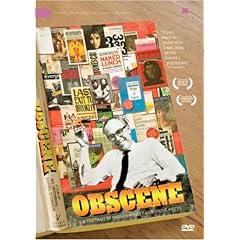
Today's video features the trailer for Obscene, the acclaimed 2007 documentary on Barney Rosset and Grove Press. The film is available on Netflix and at Amazon. Enjoy!