Showing posts with label An Essay on Writing. Show all posts

Thursday, March 12, 2009

What's Your Excuse?


An Essay on Writing
by Mridu Khullar, international freelance journalist

In the years that I’ve been writing, I’ve interacted with thousands of writers. It concerns me deeply that as much as writers like to blame outside influences for our lack of success, or even lack of effort, we’re our own worst enemies. In the years that I’ve been active in the writing community, I’ve met many talented writers. And I’ve heard many different variations of the excuses I list below for not following dreams.

I’ve finally decided to counter them for you. Which one is yours?

“I have no money.”

A variation of this is: “I have to support my family” or “I have to pay my bills.” It’s a valid concern, but it’s still an excuse. The solution to this is simple:
  1. Simplify your life: cut out the excess expenditure, make do without some things for a while, and save, save, save.
  2. Find free resources to fund your writing: borrow your best friend’s computer, visit the library to find magazines, read while waiting at the doctor’s office, get online for advice and research.
  3. Invest what you earn: Whatever little you make from your writing, put it back into writing. Buy a how-to book, save for a conference, or get that computer.
  4. If you don’t earn from writing, don’t fret. Keep at it. An hour a day. Nothing more, nothing less. Do that until you’re able to do more.
“I don’t have time.”

Yes you do. You simply haven’t made writing a priority. One hour a day– before the family wakes up, after everyone’s gone to bed, in your lunch hour. If you can’t do that, write in ten minute increments. They add up. If you can’t do ten minute increments, do five minute timed exercises. Or 100 words a day. Other ideas:
  1. Make a date: On Sunday, at 4 p.m., you will do nothing but go to the local cafe and write. Pick your time, pick your place, tell your family you have a meeting with someone important, and just do it.
  2. Punish and reward yourself: If you don’t meet your weekly target (keep it small), you have to do the dishes for a week. If you do meet it, your husband does.
  3. Involve your family: Make it something you can do together. You write and your kids draw. Or you write, and they write. Or if they let you write, you’ll read what you’ve written to them at bedtime.
“I’m a woman/I’m gay/I’m Indian/I’m fill-in-the-blank.”
  1. Google “woman writer” or “gay writer” or “Indian writer” or whatever it is that you think is part of your personality that hinders you from your goal and see how many people in the same situation have made a name in that sphere.
  2. Use your differences in your work. If there’s something different or unique about you, write about it.
  3. You are a person first and foremost. If you believe that, there’s no reason why your readers or editors won’t.
“I have no talent/I don’t have what it takes.”

It’s sad how many talented, truly talented, people don’t recognize their genius. Which is possibly what makes them so special. However,
  1. You don’t have to be super talented to write. If you enjoy it, do it anyway, and then throw it away. What’s the big deal?
  2. Don’t aim for publication. Just write because you enjoy it. If you’re on this website reading this, you clearly do. So write. Why attach so much importance to the results of that writing?
  3. Be a talentless writer. I don’t think I’m a talented photographer. I take pictures anyway. It’s fun. Is writing fun for you? Do it.
“I’m too old/too young.”

In her book, The Artist’s Way, Julia Cameron talks about this man who wants to learn how to play the piano, but keeps delaying getting started. He says, “Do you know how old I’ll be by the time I’ve finished learning?” and she replies, “Yes, the same age you’ll be if you don’t.”

I can’t really say anything better than that. There are people who have published their first novels at age 18, there are those who’ve done it at 90. Age is, very simply, the most ridiculous excuse for not following a dream.

“But that’s crazy!”

Some of the greatest ideas are. You won’t know if it’s worth devoting time on unless you actually explore it.

“My spouse/partner doesn’t like it/support it.”

And you don’t like it when your wife gets a manicure every week or your husband parks his butt in front of every football match ever played. Your writing is either your job, in which case your spouse doesn’t get a say in how you choose to work, or a hobby, in which case your spouse doesn’t get a say in how you choose to spend your time away from him/her. Some other ideas:
  1. I’ve had people in my life who haven’t understood this crazy obsession with staring at a blank screen. It’s usually due to a lack of understanding on their part, and a lack of providing proper explanations on mine. If you share your process, share your enthusiasm, and make your spouse understand why it’s so important to you, you’ll have much more support.
  2. Sometimes though, unfortunate as it is, there’s no amount of explaining that’ll get you anywhere. Let that be. It doesn’t mean you have to give up writing, it means you simply give up trying to explain and feeling bad about it. Taking time to do something that fulfills you, whatever it may be, is not unreasonable.
  3. We all have our little quirks. For me, it’s that I like playing Tetris (www.freetetris.org) when I’m blocked on a story. While to someone standing behind me, it might look like I’m playing a game, I’m really figuring out how to organize my story. Things like that might need to be explained, especially when your boyfriend hands you a steaming cup of tea because you’ve been working so hard, only to discover you’ve beaten his top score!
  4. When you’re away from your writing, be away from your writing! Yes, it’s tempting to talk about it all the bloody time, and to wander off into space thinking about your characters when your husband is yet again talking about his boring office politics, but this is seriously the best piece of advice you will ever get on this topic: don’t make your partner compete with your writing. They can’t do it, they’ll never feel like they win, and they’ll end up detesting something so important to you. Not good. (And yes, I did learn this the hard way.)

Friday, February 27, 2009

On Being Prolific and Other Writing Myths


An Essay on Writing
by Wayne Scheer

People think of me as prolific because hardly a week goes by without my Yahooing that a story of mine got published. Of course, this may simply mean that I'm a braggart, but that aside, I've published more than two hundred stories, essays, a collection of short stories and one lonely poem in about seventy-five different publications over the past eight years. The numbers sound impressive--they impress the hell out of me--but I don't think of myself as prolific.

After all, if I were truly prolific, wouldn't it be easy to write this? Instead, it's taken me nearly an hour to compose the opening paragraph--and I'll probably change it completely by the time I'm finished.

That may be the first step towards being what folks think of as prolific: accepting that writing is hard work. We all know the old line attributed to various writers about how easy it is to write. All you have to do is stare at the typewriter (or computer) until blood drips from your eyeballs. The writing process may not be quite that traumatic, but knowing that writing takes time reminds me that I have to make the time to write. It helps that I don't have a life, being retired and all, so I can sit in front of my computer most weekdays. (My wife owns me weekends.) I eat breakfast and lunch at the computer, drink a pot of coffee and would probably eat dinner there as well if I didn't fear my wife. (She suggests I change that to "respect.") I take off about two hours a day to exercise or garden or read. That's my life.

I'd like to say I spend all that time writing. I spend much of it reading and responding to stories from the Practice and Fiction groups. Although I fear critiquing is often a form of procrastination, I'm also convinced it's an essential part of creating new work. Identifying what worked and didn't work in other people's stories is, for me, like batting practice for a ballplayer. It gives me a chance to consider various techniques and to recognize stylistic kinks.

I also try to write every day. The weekly prompts in Practice help guide me and offer me a deadline in order to limit my procrastination. I also spend time each day revising old work. I have a file of well over five hundred stories, many just story starters of two hundred or so words. When I first retired I joined another online writing group that required one story under two hundred and fifty words and another under one thousand words a week. Like Practice, they offered weekly prompts. Not having a supply of old stories, I wrote new ones most every week for a couple of years. Much of the writing isn't good or wasn't good initially, but through the years I've revised some of the ideas into twenty-five hundred word stories and others into under a thousand word flashes. That's probably the main reason I don't think of myself as prolific--because most of the stories I publish I know are rewrites of things I wrote years ago. Even many of my weekly subs to Practice are rewrites of old ideas.

But I think that's another important reason I appear prolific. Instead of deleting old stories that went nowhere, I rewrite. Sometimes, better stories and characters emerge. Sometimes not. I play a game with myself. I want everything in my files to sound, at least, literate. I imagine my son--who's a far better writer than I am--or my grandchildren reading my files after I'm dead, and I don't want to be embarrassed by my detritus. Often, fairly decent or at least passably decent stories emerge, somewhat like the Phoenix, mixed metaphors and all.

The next step towards being "prolific" is to show no shame and let my fellow IWWers have their say. I do this weekly in Practice, and when I write a longer story, I let the Fiction folk critique. One of the benefits of my critiquing as many stories as I do is when I send a story out to the group, I get a good many responses. And many are very good. I take all critiques seriously, even if I don't follow all of them. But there's nothing more helpful than getting a sense of what readers are thinking and feeling while reading a story of mine. This makes the IWW invaluable to me.

Again, showing no shame, when I revise a story to the point where I like it, I send it out to what I think may be an appropriate publication. I probably have twenty-five stories out at any given time. Twenty will likely be rejected, but that means I'll be able to Yahoo five of them, which makes me appear prolific.

How do I find new markets? That takes time, but the easiest way is to piggyback on markets other IWWers have yahooed. Also, I belong to a few market newsletters--Flash Fiction Flash, (monthly) CRWROPPS (almost daily) and Duotrope (weekly) are the most useful for me. Another good source, although time consuming, is to follow the links in publications that include my work and to check out the bios of writers who have published in these magazines. They list places they've published and many are new markets for me. I send stuff to as many different markets as I can, and when I find friendly editors, especially if they pay, I deluge them with stories until they beg for mercy.

So when people say I'm prolific, it's not false modesty that compels me to shrug off the compliment. I guess what I have to learn to do is wipe the blood from my eyeballs and just thank them.

Tuesday, February 24, 2009

Bylina's Top Ten Ways to Overhaul Your Novel


1. Save everything. Throw nothing away. Put it a separate file folder. Read either Bird by Bird by Anne Lamott or On Writing by Stephen King.

2. I have no experience with all these fancy-dancy software programs and just use old reliable MS Word with a decent format set-up. (Stop laughing y'all at poor old Billy Gates and his current financial woes.) Though software helps some people, it's still all about the story. Tattoo that on your forehead so you see each time you look in the mirror.

3. Write a 25-word synopsis of what it is you think your story is about.

4. Then, write a 250 word synopsis of what the story is all about. Refine it. Capture the essence of what you thought you were doing.

5. Recapture the goal, motivation, and conflict for your three or four main characters. See Debra Dixon's Goal, Motivation, and Conflict if you need to. Borrow it.

6. Create a story arc for your story. Perhaps reread Story by McKee for inspiration. What is the:

  • Inciting incident...the event that actually starts the story.
  • Plot Point One...the event that changes something fundamental about what the protagonist thought was true.
  • The Midpoint...where the protagonist's world is changed 90-degrees.
  • Plot Point Two...Where the protagonist realizes what he/she must really do to achieve the goal identified early in the story.
  • Black Moment...When all seems lost for the protag.
  • Climax...When the protag rises above antagonist.
  • Denouement...When real life returns forever altered.
7. Start with your strong suit (plot, character development, narrative, POV [whose story is it]) and analyze the above. Everyone has a strong suit.

8. When your mind is settled, work on the rewrites or blow it up and start over.

9. Don't let us make up your mind for you. Us poor critters will drag your sorry butt all across the scope of the literary world based on our own preferences and it might not end up being your story but a collaborative effort of shotgun comments on the submitted chapters. IWW's strength is on chapter by chapter peaks into the progress of the story; it's weakness is the holistic view of a novel that we see sporadically over six months or more.

10. Have lots of beers during steps 3, 4, or 5 with two or three trusted friends.

Wednesday, February 4, 2009

On Being a Mid-List Author


My life on the mid-list
Published 02.03.09
By Cheris Hodges

"What I didn't know was that unless you're with a large publishing house, like a Random House, and your name is Dan Brown or Eric Jerome Dickey, you've got to do your own publicity."

Read the full article here.

Tuesday, September 9, 2008

What Does Graffiti Reveal?


I'm a member of the Practice workshop of the Internet Writer's Workshop, an excellent place to improve your writing, and have a little fun turning out short exercises written to order.

The topic to write on this week was a 400-word story in which the conflict revolves around graffiti, an interesting topic. The stories trickled in, as they always do, and I read each one with interest. Then I noted a definite trend.

Almost every story had an underlying thread of violence. Murder, abuse, suicide, rape. And I wondered why.

I've seen graffiti that was beautiful. I've stopped to smile at graffiti that was humorous. And yes, there were some that depicted violence, racial slurs and hate. But in a mix of stories about this topic, I expected a like mixture of themes. Why wasn't this so?

Perhaps the violent graffiti had more of an impact and remained in the memories of the writers longer. Perhaps, because a lot of the time, spray painting walls, cars, and fences is illegal, so the resulting stories referenced illegal and violent activity.

Whatever the reason, I found the trend a bit unsettling. Is violence taking the place of beauty and humor in our world? If so, we have lost a great deal of what makes life a pleasure.

Friday, August 22, 2008

IWW Member Wins National Honors


Paul Fein, a long-time member of the nonfiction critique group of The Internet Writing Workshop, recently was notified he has been recognized for writing excellence by The United States Tennis' Writers Association.

Paul said, "Our group improved these articles. I'm very grateful ... " after being recognized in three different categories ...
Service Story

  • 1st: Paul Fein, "Playing Drop Shots," Sportstar

Hard News/Enterprise
  • 2nd: Paul Fein, "How Successful Is the U.S. Open Series?" Sportstar

Feature Story (Pro Tennis)
  • 2nd: Paul Fein, "Tennis for the Bloody Fun of It," The Black Rock Masters

Paul will receive his awards September 3rd at the Media Center during the US Open Tennis Tournament.

Friday, August 15, 2008

"It Was a Dark and Stormy Night"


The Bulwer-Lytton Fiction Contest 2008 Results were announced recently. My favorite, although it's difficult to pick only one, is the work of one Paul Curtis of Randburg, South Africa ...

"Let's see what this baby can do, Virgil," said Wyatt, as he floored the Charger, brushing a Dart out of the way, sideswiping an oncoming Lancer, rear-ending a Diplomat, and demolishing a row of Rams before catapulting head-on into the sheriff's Viper -- realizing that we'd indeed missed the turn-off to Abilene and ended up instead, in Dodge City.


Wednesday, May 28, 2008

To outline or not to outline, that is the question~

Who would think Stephen Hawking could help you be a better writer? Dave Swinford uses a scientific principle to explain how order and chaos can affect your writing.

Order and Chaos
by Dave Swinford

Do you outline? This was the question posed to a group of published novelists. Answers varied from the extremes of "I just try to write a minimum number of words each day, and I never know exactly what will appear when I begin to write," to "I always try to have an outline before I begin to write." However, even those who utilized an outline agreed that one had to be flexible. At some point in the process, characters might begin to assert their independence and simply refuse to follow the outline.

Most of these novelists have written and successfully published multiple novels, and there seemed to be unanimous agreement that characters often did become independent, refusing to behave as the author intended, and when this happened, the author needed to listen because more often than not, the characters were correct. Characters asserting their independence was a good thing. It often made for a stronger, more layered novel.

Stephen Hawking has said that the science of this 21st century will be the science of complexity. This new science asserts that if there is too much order, things become so stable that they become fixed and unchanging. If there is too much chaos, the lack of any stable framework means that nothing is reliable or firmly fixed. Thus, life can only exist at the balance point between order and chaos.

At the balance point, there is a reliable framework, a day-to-day flow of events that enables life to develop and thrive. There is a reasonable expectation that events will follow some stable and reliable patterns. Yet, there is enough chaos or uncertainty to provoke change, especially the sort of changes we think of as evolution.

In a sense, a thoroughly outlined novel may bee too stable and too fixed. It may lack a feeling of natural flow or of evolving in an organic manner. Perhaps the introduction of some chaos in the form of independent behavior on the part of certain characters may be a beneficial thing. It makes the novel more organic and more reflective of the natural tensions that generate life.

To have one's characters acting as an element of chaos may be a way in which our creative consciousness introduces aspects and depths that we never considered when mapping out and outlining the story. As those published novelists observed, this can improve a story. How this actually happens, the why of characters attaining independence, would, I think, provide a good topic for a future blog essay.

In the meantime, perhaps it will be enough to allow for a bit of chaos in your planning and execution of your next story.

For an introduction and basic tutorial on complexity, click here.

Thursday, April 24, 2008

Writing's Darlings


An Essay on Writing
By Dawn Goldsmith

I recently discussed killing your darlings with another writer. Seems that us writers have favorites and cling to them even when they are all wrong. A phrase that seems particularly expressive or alliteration that sings or a detour in the middle of an essay that leads nowhere, but sounds good. They jump out at us and we embrace them because they make us as a writer feel good. "Look at that, I wrote that, isn't that literate? Isn't that creative? Isn't that just exceptional?"

Often these darlings are just that -- exceptional pieces of writing -- but they just don't fit the voice or the form or the topic. The wrong word in the wrong place no matter how beautiful the word is still the wrong word.

But essay writers know that often an essay starts with a darling of a different sort. A favorite anecdote perhaps. A scene -- like the one of my husband walking across the parking lot with me as we enter a quilt show admonishing me to "don't even try to talk about those blankets to me." And him standing with his arm around the guest speaker at the quilt show, grinning like an idiot while I snap their photo and listen to him tell her, "Quilts? Oh yeah, I like quilts, yep I like quilts a lot." It begs to be turned into an essay.

Recently I experienced an essay moment while thumbing through my most recent issue of Mid-American Review. It is published by Bowling Green University and they actually published one of my book reviews there. Bowling Green was my Dad's home town and it is the college I would have loved to graduate from, if I could have had that opportunity. So I have a soft spot for the university and the publication. Otherwise, I probably wouldn't subscribe because I'm always intimidated to try reading it.

This whole intimidation factor came into play when I read a poem that appeared in the magazine. Now, poetry is even scarier to me than literary short stories. I started reading with the expectation of not understanding a word, but it spoke to me and I truly felt my world shift and my creativity soar and well, I turned it into an essay.

Of course my first choice to submit it was Christian Science Monitor. They always get first dibs on my kinder-gentler essays. This one though had a four letter word in it and well, it wasn't the usual fare I send their way.

To my surprise the editor liked it. And even more surprising, she did very little editing. And well, my little ode to poetry and all its angst is up on their website today in celebration of Poetry day or week or month, whatever it is.

It is one of my darlings. One that made me feel a bit vulnerable admitting my unsophisticated reading limits and the fear factor when addressing poetry. I don't know how readers will respond to the piece. For me it is a milestone. I feel it is one of my better efforts. I hope this darling proves to be worth keeping.

Thursday, April 17, 2008

The Bicycle-ness of Writing


An Essay on Writing
by ryan stuart

It was the stars, I swear. It was the galaxy of shiny little stars that made me want to be a writer.

Fourth grade. Picture a 1960s classroom, pictures of famous dead white guys (no black guys, no women) on the walls. A room full of white kids. Little white milk cartons passed out at snack time. A class probably bored and hot (it's Phoenix, before the installation of air conditioning everywhere), fidgety, except for me: I am rapt.

My teacher stands before the class with my alien-invasion story. It's covered with little stars.

She's explaining to the class that this is a great story. And she's explaining that it's a great story because... because I used concrete details (inventing an interview with Time magazine). Because I used dialogue. Because there was suspense. And so on... I had no idea I had done anything special.

But as she talked a fuzzy thing became clear: writing was not a mysterious gift. It was not a dispensation from a nebulous and possibly cranky muse. It was just a skill, a craft, and if one applied oneself, one could learn it. Writing could be taken apart and understood as easily as taking apart a bicycle. Granted some bicycles were more complex than others, but all could be reverse engineered.

And if one studied enough bicycles, bicycle-ness would eventually, like a photograph in developing solution, come clear.

So I set out to read. For thirty years I read about 150 books a year. When I was busy dropping out of high school, I could usually be found hanging out in an empty lot with a book. When I was in the Army I used to go to the firing ranges with a paperback. In college majoring in English, I and a friend would pile up our books and measure the height of the stack each semester (as I recall he kicked my butt with a 3-foot stack one semester).

I am without doubt a book junkie. There are alas no 12-step programs for me.

And for the last five years I have turned serious attention to writing. I've spent a couple years writing short stories, screenplays, and a stage play. A novel died of bad timing, but that's ok , lesson learned. I find I now pretty much have the chops to say whatever I wish to say, although I don't always know what that is until I begin to write. Writing to the length of a novel is still daunting, but I've no doubt I could do it.

And I have blessedly run out of excuses. I found my writer's voice (a suspect phrase to me) by putting enough words on paper. I can't claim I have no time, because I know I can in fact devote a couple of hours a day to writing, and that's all it takes. I've made dreams of fame and fortune walk the plank, because they made me fret over whether what I wanted to say was marketable. One might as well chop off my fingers. I have finally grown up enough to be self-disciplined (I think that was the hardest part). I've even spent a year choked and mute because of... who knows, I don't believe in writer's block, not really. But there it was.

And now I am ready to embark. This year I will write a full-length work, either a novel or a stage play, and polish it and re-work it and perfect it, and even try to sell it. This is not wishful thinking, this is a fact. I believe my long apprenticeship is over.

Tuesday, February 5, 2008

Writing for Children

A How-to Essay on Writing
by Margaret Hamill


You want to write for young children. You have an idea for a story, and you imagine it published in a magazine, maybe Highlights for Children, or Cricket. You see little kids listening with eyes wide, and mouths open as someone reads your story to them. This is a great goal. With effort, enthusiasm, skill, and persistence you may have a good chance of succeeding.


Here are a few things to remember as you prepare your manuscript:

Just as in stories for older readers, you must have an interesting plot and make your characters come alive on the page.

Include excitement, or tension, lots of dialogue, and plan a great ending to your story.

Consider the age of the child you are writing for, the reading level, and the current interests of children.

Does that sound difficult? It really isn't. Just remember what you liked to read when you were younger and try to create a similar story.

  • What do children want in a story?
Children want action, mystery, humor, and excitement. They like to laugh, be surprised, and maybe just a little frightened. Touch their hearts with emotion, and tickle their funny bones with humor.

Give enough description to place them in the story, but no long paragraphs. You don't want them to toss the book aside out of boredom.

Finally, and this is very important, don't allow an adult to come into the story and solve the problems. Children like to identify with the main character, and be a part of the intrigue. They enjoy trying to solve the problems, or the mystery, as they read the story.

  • What do editors want?
If you are writing fiction, remember its purpose is to entertain. Your story should start off with something to grab the reader and hold his interest. Editors often advise writers to discard their first page, or chapter, and begin further along in the story where things begin to get exciting.

Maybe you would rather write an article, or a true story, something exciting that others might like to hear about. There is a good market for non-fiction at this time. Editors are looking for interesting articles about science, animals, the environment, historical events and characters.

Kids are curious about the world around them, but the facts must be clothed in interesting wrappings. Avoid dull encyclopedia-like texts. Non-fiction for children should entertain as well as teach. Colorful pictures, or drawings, informative, well-written text, and current, fascinating subject matter will often sell your manuscript.

  • Where do you get ideas for writing children’s stories and articles?
Look around you. Watch children. Notice what they talk about, what they wear, and what games they play. Focus on hot topics and current interests of kids in the age level you are writing for.

Search your own childhood. Did you have an interesting experience that would make a good story? You can fictionalize it, and change the facts and characters as you please. Your memory can be a vast storehouse of ideas.

Read children’s books--lots of children's books. Carry them out of the library by the armful. Discover which books children check out again and again.

Visit the bookstores. See what’s out there.

Talk with kids. Ask questions that require more than a 'yes' or 'no' answer. Listen to children talking among themselves. Notice how they put words together and what they talk about when they are at play.

Watch kid’s shows on television. Even the cartoons can give you ideas.

Carry a notebook and pencil so when the ideas come, you can write them down before you forget them.

  • You've written your story or article. Now what?
When you have finished writing. Read your story out loud, maybe to a younger friend. Correct mistakes and make it as interesting and as neat as you can.

Search the markets to find just the right magazine for your type story. Look in the Writer's Market, in writer's magazines, and online for publishers.

Finally, prepare your story for the publisher. Be sure your manuscript is properly addressed to the correct editor. Type it double-spaced, with no misspelled words. Put your name, story title, and the page number on each page.

Create a cover letter introducing your story and include a paragraph about your writing experience, if any. Tell the editor why you think your story would fit in his magazine.

Prepare a self-addressed, stamped envelope for an acceptance from the editor, or for the return of your story.

Package everything in a sturdy envelope. Make sure you have enough postage on it. Drop the envelope in the nearest mailbox. You have taken that first important step toward publication.

Now the waiting begins. When that return envelope comes back it could contain an acceptance. If it happens to be a rejection, don't be discouraged. Be proud. You are a writer, and you believe in yourself.

Before you lose your nerve, repackage that precious manuscript and send it to the next publisher on your list. Remember Gone with the Wind, by Margaret Mitchell, was rejected about twenty five times before it finally was published, so there is hope for you.

Thursday, January 3, 2008

The Objectivity of Critiques

Thoughts on Receiving Critiques
by Rebecca Coleman,
Author of In Stereo Where Available, now available from Medallion Press

When my novel Desperado City was being critiqued, I ran up headlong against a whole lot of personal prejudices. One woman called my teenage characters "foul-mouthed kids" and told me the novel was nothing but a bunch of oversexed teenagers who didn't know how to respect their elders. If that's not a prejudiced view, I don't know what is. But you know what? Although those criticisms were harsh and prejudiced and sometimes downright mean-spirited, they caused me to make major and overwhelmingly helpful changes to my novel.

I realized I needed to amp up the deeper meaning I intended in the story and add in some meaningful and fulfilling relationships between the teenagers and the adults in their lives. I still maintain that this critiquer (no longer on the list, as far as I know, although I could be wrong) should have been much less abrasive and taken my story far less personally. At the same time, to this day, she is the critiquer I love to hate and hate to love because her comments forced me to write at a higher level.

To become better writers we're here to bury our writing, not to praise it. You may not like your readers' reactions, but your writing career is composed of readers reading, not standing on a stage while your fans throw roses at you. Criticizing the preferences of various readers is absolutely self-defeating. If you don't like a critter, don't crit for them. If you don't like their crits, throw them out. Cultivate the group of critiquers whose comments help you improve your work.

Don't we all know that already?

If the reader doesn't see something, it's because you didn't put it in the story. You might think you did, but the reactions of your readers indicate that you did not. That is what I'd call "helpful feedback."

As a critter I try to read with broad objectivity. For example, I don't like crime novels, but I can appreciate good writing within the crime genre and crit accordingly. Last year I critiqued a fantasy novel from head to toe, and nominally I loathe fantasy -- but the author is a great critiquer and a terrific writer, and I believe her book will have broad appeal within its audience of fans.

Let's put it this way. What I want is critiquers who will help me beat my novels into publishable shape, mainly by shaking me out of my delusions about my own writing. And I got that on the IWW, so all's well as far as I'm concerned. If all you want is someone to tell you if [read: "that"] your story is interesting and if [read: "that"] your characters are well-drawn, then it's a lot more time-efficient to hand your novel to your relatives than to spend time returning critiques.

If you're going to spend the time reading and returning crits, you should have much higher standards for criticism than that. Are you politely criticizing your critiques in your thank-you letters? Bad idea. Do your crits for others say the story is fine and developing well -- in an effort to give such a simple and broad read -- when others are saying the story is dreary and the writing sucks? If either of those things is true, that probably explains your frustrations. You won't cultivate a devoted group of really good writers that way.

One last thing. If you're hoping to sell your work at any point, you'd be well-served to allow people to criticize your work on their terms, not yours.

Reviewers -- both professional and of the Amazon variety -- don't give two craps about your opinion of your own novel. They don't even seem to realize books are written by human beings with feelings, who might see the review. Arguing with readers doesn't improve your work.

The only thing that does is good writing.


Find the Rebecca's novel here ...


Saturday, November 17, 2007

Immortality, Writing, and Hanging In

Immortality
An Essay
by Carter Jefferson, editor
Internet Review of Books


The recent death of Ira Levin, famed author of Rosemary's Baby, among other books, got a lot of notice on the IWW's Writing conversation list -- more than did the death of Norman Mailer a few days before. Coincidentally, I'm reading a book by Michael Dirda called Classics for Pleasure; I'll review it for The Internet Review of Books. Dirda's calling our attention to a lot of good writing that's fallen by the wayside.

All this has made me think about the "immortality" all of us writers, in our heart of hearts, would love to have.

Take J.K. Rowling. More people have read her books than anybody else's recently, but will Harry Potter survive? When I was in the second grade, my father brought home a review copy of Speedy in Oz, which I devoured. Already a pest at a local second-hand shop, I went through the entire series of Oz books, probably thirty of them, as fast as I could -- the stuff they gave me to read in school was nothing compared to those magical thrillers. All the other reader kids read them, and a few years later they got a big boost from Judy Garland. The Wizard still shows up on TV now and then. But does anybody, I mean anybody, still read those books? Has anybody but ancients ever heard of L. Frank Baum?

Then there are all the novelists who made the best-seller lists back when I was younger. I loved the works of Rumer Godden, who died in 1998. Someone wrote her biography, and her estate is on the Web, but when I mentioned her a couple of years ago only one person among 500 writers knew who she was. Give it a couple more decades, and she'll join Booth Tarkington, whose Gentle Julia is the funniest book I ever read, in writer purgatory, along with such once-bright stars as Lew Wallace and E.D.E.N. Southworth.

And have any of you read anything by Marie Corelli, who was almost as popular as Dickens?

It's a crapshoot. No matter how good you are, no matter how famous your books may be right now, you're probably out of luck when it comes to the next generation. My guess is that when you're dead you'll have better things to do than worry about your literary fame. But writing is fun right now -- painful, back-breaking, frustrating, yes. But fun, don't you think? Hang in!

Thursday, November 8, 2007

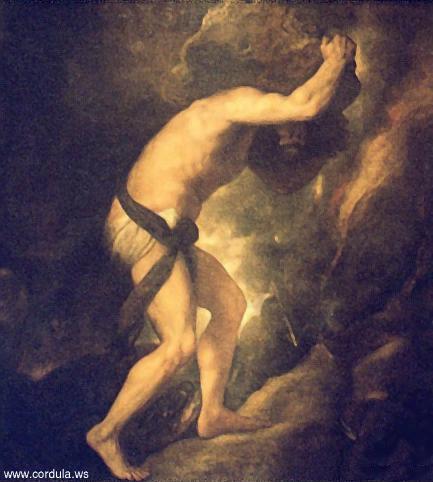
Like Sisyphus, Rolling The Rock


An Essay on Writing
by Dave Swinford

In his essay, "The Myth of Sisyphus," French Existentialist philosopher, Albert Camus, asserts that Sisyphus's situation mirrors the human condition. For toying with the Gods, Sisyphus has been condemned to eternally roll a huge rock to the top of a hill only to have it come tumbling down again. He is an isolated individual whose only purpose seems to be endless, fruitless labor.

Writing is a solitary vocation, and every writer has experienced dark moments of the soul. Your muse is being recalcitrant, your collection of rejections just keeps growing, and you feel like Sisyphus, rolling your creative rock up that hill only to have it come rumbling back down. You know you need to roll that rock back up the hill, but it's easier to just sit and stare at the computer monitor.

Imagine poor Sisyphus, enduring an eternity of such dark moments, yet Camus concludes that we should think of Sisyphus as happy. As he trudges down the hill to resume his labors, Sisyphus's thoughts turn inward, and it is there that he discovers he is truly free. The Gods cannot control his thoughts. He can make of them whatever he wills. He can scorn the Gods' attempts to punish him, be his true, authentic inner self and choose to be happy.

Camus, the existentialist, saw each of us as solitary, isolated individuals. Yet, as Sisyphus discovers, there is power in our individuality. We are all free to choose how we will edit and shape our inner landscape.

This is a truth writers discover as they labor at the craft. External validation is something to be desired, but it is the inner landscapes, the imaginings, the creative synthesis of concepts into words that provides the greatest freedom, and often the greatest validation. Writers, more so than most, understand and revel in the creative power of their inner self.

Existentialism asserts that "existence precedes essence," that we exist in subjective isolation and it is within this subjectivity that we must create our own essence. Thus, Camus could envision Sisyphus as embracing his inner freedom and scorning the Gods, but steeped as he was in the Western scientific paradigm, Camus could not imagine that as Sisyphus stubbornly rolls that rock up that hill, he might also undergo an Eastern mystical experience.

Calloused shoulder hard against the eroded granite, grunting with effort, Sisyphus might cease to think of the rock as a foe and see it as an extension of himself, as two parts of one being, forever coupled in an eternal dance. He might even extend this subjective awareness to include the rutted hillside and foreboding sky, merging them into the dance, becoming one with the totality of the process, a process in which he is both a player and a creator.

This ability to merge the inner being with the external, to extend the boundaries of self, represents the true freedom that fuels creativity. To take a flash of color, a casual gesture, the heartache of loss, a soaring insight, the fear of failure, the joys of a child, to take all these and blend them with imaginings that plunge from the inner depths to the limits of the universe is to embrace the power of the creative and the subjective. It is to become one with the rock, to merge with the process and to truly become "A Writer."


Thursday, November 1, 2007

Using Holarchies


An Essay on Writing
by Dave Swinford

In his book, The Ghost In The Machine, Arthur Koestler coined the term holarchy. It combines the Greek word holos meaning "whole" with hierarkhia for High Priest, which is a root for the term hierarchy. It is intended to describe a hierarchically organized group of independent units called holons. A holon may, in itself, be a holarchy of lesser holons.

The Internet Writing Workshop is an example of a social holarchy. Its holons are the various lists, which are themselves made up of holons identified as administrators and members. The IWW may be viewed as a holon of the larger holarchy, Internet Writing Groups, which may be viewed as a holon of Educational Writing Groups, and so on.

One advantage of a holarchy is its fluid nature, especially in social hierarchies. Holons of one holarchy might also elect to become holons of a different holarchy or group. In the IWW, this means that members of a critiquing list, such as the Non-fiction list, may also elect to be holons or members of the Writing discussion list or other critiquing lists. Thus there can be a fluid flow of holons within the larger holarchy of the IWW. Yet, if conflicts or problems arise between members or a member's understanding of list guidelines, the ability of the administrators to move up and view the issues in terms of the larger holarchy of the whole list or even to step up further to view it in terms of the whole IWW often makes the resolution clear and unambiguous.

Another advantage of this fluidity is the ability of the administrators to think of their lists as a holon of a holarchy called Types of Writing. This enables them to better define the focus and purposes of a particular list. In other words, the concept of holarchies and holons more accurately describe the way groups or categories actually interact and overlap rather than to try to mold them to fit into a rigid set of hierarchies.

This concept can apply to writing in various ways. One may approach a story or article as a holarchy of individual parts or holons. Or, a story may be viewed as a holon of some larger holarchy that might be called genres, and genres might've viewed as holans of the larger whole, market. And of course, these holarchies can be viewed in terms of more specialized holons, such as Sub-genres or Types of Publications.

Suppose your muse inspired you to do a story. You submit it for critiques, and several critters wonder if your story is Chicklit, SF or Mystery, because it contains elements of all three genres. It's a question you had not considered when writing the story, but it's something you will need to clarify if you intend to market it. Viewing the elements of your story in terms of the holarchy of genre offers a means of evaluating which of the three genres is most likely to accept your hybrid.

After considering your story in terms of the larger holarchies, you may conclude that SF is the most likely genre to accept your innovative hybrid. With a bit of luck, you may even create a new sub-genre.

Although the concept of holarchies may, at first, seem artificial and unnecessary, being aware of this tool, can actually prove most helpful when analyzing a problem. Consciously stepping back to view from the larger whole often puts the issue in a different perspective. It provides a means for reframing the problem that may simplify the solution. If it simplifies, then it has practical value. Give it a try and decide for yourself.

Links

Thursday, October 18, 2007

Tilting at a Sacred Cow


An Essay
by Dave Swinford


Chances are that you, like most writers, feel perfectly secure in referencing the "Big Bang" and its central assumption that our universe is expanding as if they are a scientific fact rather than a popular theory that was definitively refuted more than twenty years ago.

In 1978, Astrophysicist Paul Labiolette undertook a study that compared the"Big Bang" expanding universe model against the stationary universe "Tired Light" model in four different tests of the data sets. This had never before been done. The usual approach was based on a single data set.

LaViolette's study was published in the Astrophysical Journal in 1986 under the title "Is the Universe Really Expanding?" Note that it took Labiolette eight years and three peer reviews before he had satisfactorily refuted all referee's objections and the study, which demonstrated that the stationary universe "Tired Light" cosmology consistently fit the data better than the expanding universe "Big Bang" model, was finally accepted and published.

If you have never heard of Labiolette or his study, you are among the majority. The mass media did not rush to publish the findings. Popular science writers and authors of Science Fiction continued to write their articles and stories as if Labiolette's study had never been published. The "Big Bang" had become one of science's Sacred Cows, and the establishment chose to ignore anything that called it into question.

This is still the case. So much so that in 2004, a group of cosmologists, astrophysicists and astronomers published an "Open Letter" in New Scientist deploring the climate of repression that blocked funding for research and systematically rejected any studies or articles that might challenge the "Big Bang" model.

Such reactions seem unscientific and yet, there is little doubt that those who have invested much of their career in support of the "Big Bang" model are not going to willingly admit that they have supported a flawed cosmology. And this is equally true for those writers who have invested their trust in that cosmology by making it a "fact" in their articles and stories.

As a writer, I can understand this attitude. It's difficult to face the possibility that some of one's creative efforts may now be considered flawed, naive and/or invalid. It's much easier to join the establishment in ignoring the contrary data and the growing number of scientists who are openly questioning this Sacred Cow.

Perhaps it is time that some courageous authors donned the armor of research, fired up their laptops and went forth for a bit of tilting. Writers of SF could examine the stationary universe "Tired Light" models and do some extrapolating. They might even come up with original and creative speculations. Authors of SF are often well ahead of the mainstream, and this Sacred Cow offers an opportunity to be a creative pioneer.


Links:

Tuesday, September 25, 2007

Neither Fish nor Fowl, Although Sometimes Fishy and Often Foul

Humor is hard. Funny is difficult. And writing humor -- we'll refer here to a serious writer of humor, say, P. J. O'Rourke -- is neither nonfiction or fiction. It might be, in fact, a separate genre.

O'Rourke specializes in hyperbolic commentary on political matters -- "Giving government money and power is like giving car keys and whiskey to a teenage boy" -- and I was reminded of his work when I read a piece in the Washington Post by Charles Lane, Rather Ridiculous.

What's interesting about the piece is that the opening segments mock Dan Rather's penchant for country-boy metaphors -- "... hotter than a hamburger on a hickory fire."

The piece then changes into an oblique attack on CBS, Rather, and the validity of his 24 years as the anchor of the network's evening newscast.

It is sly rather than funny, at least to me, and different from the nonsense of Dave Barry or the surrealism of Stephen Wright, but, as political or social commentary, it lacks the hard, biting, ironic edge of a writer who sees the world from that prism as a permanent point of view.

Again to O'Rourke.

"The people who believe that, as a result of industrial development, life is about to become a hell, or may be one already, are guilty, at least, of sloppy pronouncements. On page 8 of Earth in the Balance, Al Gore claims that his study of the arms race gave him 'a deeper appreciation for the most horrifying fact in all our lives: civilization is now capable of destroying itself.' ... civilization has always been able to destroy itself. The Greeks of ancient Athens, who had a civilization remarkable for lack of technological progress during its period of greatest knowledge and power, managed to destroy them fine."

Of course, Lane is a writer for the Post's editorial page, and so it is unfair to compare him to O'Rourke. Or Barry or Wright, for that matter.

Friday, September 21, 2007

Look for the Injustice

An Essay on Writing
by Dave Swinford

Injustice can be a powerful motivation for your characters and an effective emotional link to your readers. Some classic tales have been propelled by the desire to right a social or political injustice. Alexandre Dumas's The Man In The Iron Mask and The Count Of Monte Cristo grow out of injustices that instill in the reader the desire to see justice done and the protagonist triumph. And of course, many of Shakespeare's plots, including Hamlet and Romeo and Juliet grow out of obvious injustices.

If an author is seeking story ideas, one source can be a consideration of life's many injustices. Simply identify an injustice and build your plot around it. Or, you may want to emulate JK Rowling, who confronts her protagonist, Harry Potter, with what appear to be numerous unfair and unjust obstacles that must be dealt with as he progresses through the story. Readers empathize with Harry. They want him to overcome these injustices, and this desire effectively draws them into Rowling's fictional reality.

Looking for the injustice is especially useful if one is writing a mystery. At the heart of most mysteries lies some sort of injustice, and the sleuth, whether a professional or an amateur, is driven to correct this wrong. This is such a given, that one may assume this injustice too obvious to be worth mentioning. Instead, the focus is on the puzzle or the battle of wits between the sleuth and the antagonist.

I enjoy reading mysteries, yet I find it difficult to recall many of those that presented a witty puzzle, which the protagonist, of course, easily solved. I may have enjoyed following the clues and trying to arrive at a solution long before the end of the book, but the stories simply do not stick with me. The mysteries I do recall are those which contained a clear sense of injustice, a sense that something badly needed to be set right. That sense of injustice made the story feel more personal; it made me feel as if I had an investment in the outcome.

The sense that I was invested in the story also meant that I wanted the unraveling of the mystery to arrive at a satisfying resolution. I wanted to close the book with the feeling that the scales of justice had been balanced. Thus, if you are writing a
mystery and you select details that create a sense of injustice for the reader, do not forget to end the story in a manner that leaves the reader with the feeling that, as much as was possible, justice has been done.

So, when planning that next story, take a few moments to consider whether injustice might be a useful way of effectively drawing the reader into your fictional creation. Consider the details and presentation that will most effectively dramatize the
injustice, and don't forget to leave the reader with a feeling that, in the end, justice was done.


Find the classics mentioned through the Gutenberg Project ...

"Injustice boils in men's hearts as does steel in its cauldron, ready to pour forth, white hot, in the fullness of time." - Mother Jones

Thursday, September 20, 2007

"He only profits from praise who values criticism." -Heine

An Essay
by Alice Folkart

I have to say that I learn more from taking a careful look at someone else's work and then trying to explain why I think it is well done or needs work, than I have from all of the books on writing I've read. I've never taken a class, so I can't count
experience with a live teacher.

If a piece offends you - language, violence, distasteful political or social views, put it down. Ignore it. Go and read something else. If the only thing you find offensive is what you consider a lack of talent and/or craftsmanship, look more carefully and see what you can learn by helping the writer. See if there is even one small thing you can say to encourage the writer before you start giving her or him the benefit of your knowledge.

I always try to find something positive to say - this is a good start, a sympathetic character, I like the way you've included sensory detail - autumn leaves crunching, birdsong waking up the hero, etc. If all you can say is, "I can see that you've put a lot of work into this," then say so. We don't gain anything, we don't become better writers ourselves, by crushing another's hope and desire to write.

The worse the piece is, the fewer nits I pick. If I were trying to build a house, I'd give up if some know-it-all carpenter stood and watched me, criticizing everything from my choice of lot and kind of wood to the way I drove a nail or tacked on a shingle. Why bother if everything I do is wrong? Why try.

So, if the piece needs a lot of work and the writer seems to have no clue I may point out some simple thing such as:

  • Did you mean to use the word usual two or three times in every paragraph? Can you find another way to express that idea?
  • The first paragraph is in past tense, and then, you switch to present tense. It confused me. Is there a reason for this?
  • I have trouble knowing who is speaking - when there are three or four people in a conversation and all the reader gets is 'he said' and 'she said,' the reader gets lost.
  • This is a pretty complex story or subject - you might want to trim it down to size - only one main problem to be solved, only two or three characters (instead of ten), only one point in time (instead of all of history) for an exercise of 300 to 400 words.
  • And, if the piece is full of typos, don't be afraid to suggest that the writer remember to use the spell checker - and reread at least twice.
  • And, if the piece has elementary grammar errors, don't be afraid to suggest Strunk & White's Elements of Style.

And, on the grammar track - if the writer consistently breaks the rules, for example, forgets to use quotes correctly, cite one example and suggest that he or she go through the piece to see and correct other instances where the same error crops up.

As for learning from critiquing - here is one example of something I learned that nothing else could probably have taught me. I found that in the piece I was reading, every sentence had the same pattern: Bob did this or that. Bob said this or that. The cat jumped. The car started. All, simple subject-verb sentences. How dull. There's no rule about this, but it did make me aware of how we can get stuck in a sentence patter and put our reader to sleep.

Read the critiques that others are giving. Disregard the lazy ones - the, "Good work. Enjoyed. You might give your characters names." kind. But pay close attention to the ones that offer specific advice.

If you've encountered something so badly written that you can't even bear to read it! Well, then, don't. Go on to something that you can read and comment on. But, think about that bad one. Can you isolate one thing that the writer could do to improve just a little bit? Offer up that tiny bit of advice and a little encouragement - "You need to make your subjects and verbs agree." (give an example from the writer's own text) "But, you've got a good start here."

Most of all, enjoy and profit from your experience as a member of The Internet Writing Workshop.