Showing posts with label writing careers. Show all posts

Tuesday, October 23, 2007

The Value of Persistence


A Report on the Writing Life
by C. Eric Banister

One of the goals I set for myself in January of 2007 was to have an article published in a magazine called Bluegrass Unlimited. If you are a bluegrass fan, this is comparable to being the Rolling Stone of the genre in terms of name recognition within the genre. I sent several queries in a row, each either already assigned or they weren't interested in the artist at the time. After about 5 rejections the editor noted that she had to admire my persistence.

I followed that up with a thank you - and another pitch. As my luck goes, it was already assigned. About a week later, I got an e-mail from the editor that the person assigned to that story dropped out and it was mine if I wanted it. Of course I did! So I had my first story (the first nice paycheck too) published in Bluegrass Unlimited in August. I have tried a few more queries, but haven't hit another story idea yet.

With summer winding down and classes starting again I hadn't had time to query for a couple of months. Yesterday I got an e-mail from the editor asking if I would be interested in becoming a regular reviewer for the magazine! It's a paying gig and one that will help build my visibility in that community.

So the lesson I offer is that persistence and professionalism really do pay off!

Wednesday, September 19, 2007

Internet Book Review Needs Reviewers


This is a recruitment poster. The planners creating the Internet Review of Books are making progress -- slowly -- and now they need a lot troops. Like, for instance, you.

We've solved some of the problems involved in starting a new book review site. Despite our having to jump through hoops to get them, the books have begin to dribble in.

But when one comes in, we have to have a reviewer to send it to. We lucked out and got one big-name reviewer the hard way, by tracking him down and talking to him on the telephone (landline). Bob Sanchez and Ruth Douillette, part of the planning group, have written reviews of two of the books we have. A few others are out there with competent reviewers. But it's going to begin to rain books pretty soon, and so far there's a drought of reviewers.

That's where you come in.

For example, just yesterday The Feminist Press told me they would send us a copy of a book about the trials of women working in a corporate atmosphere, and it will give such workers some ideas on how to deal with the subtle, and sometimes blatant, discrimination they suffer. It should be well worth a review, but who'll take on the job? The best choice, of course, is someone who is working in some big office now, but offhand I don't know any. How about you, or one of your friends? It's the same for all sorts of books, and there are hundreds of different subjects.

Since we're shooting to become "mass media," we don't have to have Ph.D.'s to write our reviews--we need sensible people who are capable of explaining to readers what's good and what's bad about a book in a field they know something about. There's some subject that you -- think about it! -- could cover well.

There's nothing arcane about writing book reviews. You learn how by reading a few in the New York Times or the Washington Post. Both of them are online.

And what do you get for this chore? A free book. Publicity for you and whatever you've written lately. And a publication -- it won't be as prestigious as a story in a literary magazine, but more than likely a lot more people will read it. One day we'll pay, but that may be a while.

Care to join us?

Write to me, Carter Jefferson, Editor, The Internet Review of Books.

Thursday, August 30, 2007

That First Amazon Review


by Diane Diekman

The first Live Fast Love Hard review on Amazon.com gave me a four because I didn't talk enough about Faron Young's music. The reviewer doesn't realize he's telling me I achieved my goal -- which was to make readers curious enough to seek out the music, listen to it, and form their own opinions.

How am I qualified to tell other people what "great music" is? I can't tell the difference between a sharp and a flat, and I had to ask another singer what to call Faron -- a baritone.

I agree with the second reviewers' comment that Faron's music speaks for itself. I tried not to tell readers what to think, because I don't like biographers telling me how I should feel about a particular recording. Especially if I'm reading a book about a person who didn't perform my style of music.

As for marketing, I'm finding that the University of Illinois Press is willing to help me set up events and ensure the books are there, but it's up to me to get myself there. This is definitely not a money-making deal.

I'll never even earn back what I spent on research, so I'm going to choose a few events that I expect to be great fun. People in Nashville and Shreveport (Faron Young's home town) and Fort Worth are working on tribute shows to Faron, in conjunction with book signings.

It doesn't get better than that.


  • Live Fast, Love Hard: The Faron Young Story by Diane Diekman
  • The University of Illinois Press says "Presenting the first detailed portrayal of this lively and unpredictable country music star, Diane Diekman masterfully draws on extensive interviews with Young's family, band members, and colleagues. Impeccably researched, Diekman's narrative also weaves anecdotes from the Louisiana Hayride and other old-time radio shows with ones from Young's business associates, including Ralph Emery ..."

Wednesday, August 29, 2007

Writing Is Painful

Emotionally ...

... and physically if you cling to the keyboard so much that you develop repetitive stress injuries. Oh, my. Those fingers and wrists and hands can hurt.

A member of the IWW posted a lament on the WRITING discussion group forum recently. My advice ...

  • Posture
  • Comfortable chair and desk
  • Monitor mounted in good position
  • Get rid of bifocals and use a pair of "computer-only" glasses
  • Type 50 minutes
  • Get up and move for 10 minutes
  • Gel pads for keyboard and mouse
  • Make certain position of arms in using mouse/keyboard isn't pinching
  • off circulation or nerve path to hands
  • Rubber squeeze ball near computer
Does it work? I'm not sure. I know I followed most of that advice, but I continued to have a subtle soreness in my wrists. The promise of more pain didn't recede until I put away the desktop and began to use a laptop -- literally, a laptop on my lap.

Another member of the IWW said " ... the writer John August recommends a keyboard on his site."

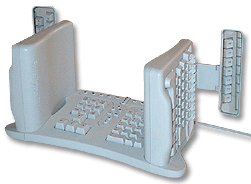
I did a quick search to find an odd-appearing, interesting device that resembles an accordion more than a keyboard.

I think I'll stick to laptops.


More on repetitive stress injury here and here

Tuesday, June 12, 2007

Intellectual Property

What you write is that: intellectual property.

Like other intellectual property, it has value. And, when you die, you want the things of value you own to go to people you chosen.

That's why a smart writer should visit Neil Gaiman's Web site and read his take on intellectual property and wills.

Who is Neil Gaiman and why should he worry about intellectual property?

"Bestselling author Neil Gaiman has long been one of the top writers in modern comics, as well as writing books for readers of all ages. He is listed in the Dictionary of Literary Biography as one of the top ten living post-modern writers, and is a prolific creator of works of prose, poetry, film, journalism, comics, song lyrics, and drama."


As with other references and pointers on the Internet Writing Workshop Blog, the administrators, individually and collectively, assume no responsibility for the accuracy or honesty of the information. Writing is a tough business. Caveat emptor.

Tuesday, May 29, 2007

Miss Snark

If you're a regular reader of the IWW Blog, you're aware no doubt one of the first RSS feeds from another writing blog was that to Miss Snark, the anonymous persona reporting from deep in the bowels of the beast we call the publishing industry.

Miss Snark has retired.

Oddly enough, as important as this person appeared to be to writers-attempting-to-be-published-authors, if you write "Miss Snark" in the search mechanisms of The Washington Post or the New York Times, you find to results.

On the other hand, if you write "Miss Snark retires" in Google, you'll find laments by the score from bloggers and from e-publications like The AbsoluteWrite.

And this from a site supposed to have attracted 2,000,000 visitors! One would think Miss Snark could have turned that amount of traffic into an advertising bonanza.

I wish I understood all I know, and know all I think I know.

Wednesday, May 16, 2007

How to Choose Sample Chapters for Literary Agents

An Essay on Marketing
by Ally E. Peltier


A member of our IWW Writing discussion list recently posted that she'd been advised by a friend never to send a Prologue as part of the first three chapters she sent to prospective literary agents. I worked as an acquiring editor at a major publisher for years and know and still work with many agents. I have never heard this rule about not including a Prologue. I would say that people giving this kind of advice may be influenced by the new author's tendency to rely on a Prologue when one isn't necessary--thus, you are in effect sending a weak opening to a prospective agent.

This is obviously something to avoid. But unless the agent specifies otherwise, you should send the first three chapters or approximately 50 pages, whether that is a Prologue and two chapters or three regular chapters doesn't matter.

I had a client who recently wanted to send the first chapter, one from the middle, and one from the end. I strongly encouraged him to abandon this plan, and the reason why is also the explanation for why sending the Prologue (if you have one) is important.

Most potential book buyers will browse for books in a certain way: cover or title catches the eye, back cover/jacket copy is intriguing, and then the first couple of pages delivers on the promise of the cover copy. Book reviewers and media personnel (like the folk who decide who will appear on their bosses' TV shows) sometimes take it a step further, giving anywhere from just the first paragraph to at least the first chapter a chance to grab them. Editors know this, and it is the reason why the openings of novels are so carefully scrutinized.

That's why agents also ask to see the first few chapters. Because, it is again assumed, if the first couple of chapters don't grab the agent, then it similarly won't grab editors, reviewers, and so forth.

So, if your reasons are similar to my client's (he felt that the story didn't really pick up until midway through the novel), you should spend more time working on your novel's opening rather than choose a haphazard selection of chapters to send. Since most agents expect to see a synopsis as well as sample chapters (even if they don't ask for it, you have a better chance of having them ask for your manuscript if you send one), your overall plot arc will be clear to them regardless of what happens in the first few chapters. It will give them some context. But those first chapters must be gripping, interesting, and compelling enough to make the agent want to keep reading. They should introduce your protagonists and show the agent that you have a good handle on natural-sounding dialogue, well developed settings, and the appropriate pace or tone for your genre. If they don't accomplish these goals, the agent won't bother asking for more material.


Ally E. Peltier is an editor, writer and consultant who began her editorial career at small publisher Brundage Publishing, then worked under the tutelage of a Senior Editor at Simon & Schuster where she spent several subsequent years acquiring and editing books for both the Touchstone and Fireside imprints. She has also worked as a freelance writer for over eight years.

Wednesday, May 9, 2007

Tips for the Beginning Freelance Copywriter

A request for help was recently posted on the IWW's WRITING list noting "I would like to see a good c.v./résumé ... to attract a staffing agency to represent me for short contract writing jobs. I would also like advice on what pieces or types of pieces to put in a portfolio.

Bob Sanchez, a retired senior technical writer who produced countless manuals and bulletins, replied. Bob knows the game, although he is now writing novels, including When Pigs Fly, part crime caper and part love story, and totally entertaining.

Here's Bob's advice ...


Do try Monster.Com, though, and the employment pages of some of the major dailies. If you live in New England, for example, check out Boston.Com.

I can send you my old resume if you like (I'm determined never to use it again), since the formatting - and content - served me well. A general suggestion is to highlight the experience most like the type of work you're looking for and either summarize or don't mention the rest. Don't worry about fancy resume paper - nobody will care. Use a standard font.

If you go through an agency, chances are you'll be interviewed twice: first by them and then by their client. Find out if the agency wants to see your portfolio; chances are, all they want is to know you have one. That's what their client wants to see.

For your portfolio, select only your best, most relevant work. Under no circumstances should you bring a fistful of loose papers to an interview and call it your portfolio. Check out Staples for professional-looking binders - I used Velo Binders, which were very satisfactory. You do the binding yourself, but there's nothing to it. Remember that while your prospective client looks mainly for content, your professional presentation can mean the difference between you getting a contract and not.

Two nice touches to set you apart: Set up a professional web site. Do not send them to your current page, where your titles include references to "Sex Magick." I've made that mistake of showing interviewers my personal website, which probably didn't do lots of harm but certainly did me no good. The point is to tell people just what they need to know about you to offer you the contract, and no more. It's okay if you tell them about your creative writing - briefly - but don't highlight it and don't offer to show it. So you'd find it well worthwhile to maintain a separate web page.

The other nice touch is to create a CD with plenty of relevant material and bring it to the interview. Tell the interviewer you made a copy just for them to keep. At my Intel interview, they ran off to get a laptop and looked at the CD then and there.

So anyway, I'm going to quit writing now, because it'll give me nightmares about going back to work.

Saturday, April 28, 2007

A Successful Writer on Writing

Random thoughts from the quicksand
by Richard Lewis,
author of The Flame Tree and The Killing Sea


  1. I write daily, 1000 words (contract deadline helps wonderfully to motivate) which sometimes takes only an hour, meaning there are many hours left in the day to do and to be other things as well.
  2. If I go into a bar and meet a man (or woman) who says "I'm a writer" when I ask him what he does, I assume that his writing is what's paying for his drink.
  3. I've sat for an hour in front of my computer and nothing comes, another hour where a hundred words finally comes forth each one like a gnaw on granite, and yet another hour where those words are changed until erased until I'm again left with a blank monitor, and I consider this all part of writing.
  4. Thinking can indeed be part of writing--much of my pre-sleep thoughts have to do with what I'll be putting down on paper when I get up (after my mediation and kids which always come first). So that does help reduce the actual time, although not as much as one might think, because I find that it's during the actual act of writing where my thoughts are not only formalized but also actually come to me out of nowhere (I suppose the previous thinking time might have cleared the underbrush for the latter to happen)
  5. I've been writing since I could read. Wrote my first story when I was six, about a yawn that traveled the world. I knew that writing was my talent,but I wanted to be other things. I didn't start writing seriously, daily, until ten years ago, when I was 40. It took me four years and four learning curve novels to finally write one that was published. I had to put in the time to struggle and fail and learn--and that time I had to put in in order to be a good and competent writer was the time I spent writing.
  6. Well, I lie--part of of learning to be a good writer is reading, reading, reading (with a critical eye helps best of all. I also found several craft books to be of help (and how-to books is another contentious issue).
  7. Still, in order to improve as a writer, I had to write! And writing every day made me improve faster. This is another area where I don't see a short cut.
  8. I would still prefer to be a world class mathematician than a writer--math at it's highest level is to me an art, and a mathematician can discover something that's never been known before, and for the rest of history he or she will be known as the discoverer. Writing? There is nothing new under the sun, just new ways of saying the same thing.
  9. I procrastinate by writing these posts.


Read more from Richard Lewis on his blog, where he notes, "I was born, raised, and live in Bali, Indonesia, with my family. No TV as a kid, read lots of books. Wrote my first short story at 6 about a yawn that traveled around the world. University educated in the States. Bailed out of a marine geology PhD program due to technical difficulties with my soul, which did not want to be shackled to a career. Bounced around. Surfed a lot. Didn’t start writing seriously until ten years ago. Now I’m pretty obsessed with it. To the horror of my old surfing buddies, I take as much pleasure in turning an original phrase as in getting tubed."

Tuesday, April 24, 2007

"Getting the Word Out"

... information from the library of Mona Vanek

Back in 2002 I saved information from an article © 2002 by Ken Hill, writer and online entrepreneur, published in the May 17, 2002 issue of HOME INCOME QUARTERLY E-DITION! BizOpp Edition, a free E-Mail Newsletter, Mona writes, and "offers advice on how to reach a broad range of ezine publishers. Hill said, You can submit your articles to directories that list articles for publishers to use as content in their ezines.
TIP: Be sure to check each ezine's submission policy before you submit your article. These sites do not pay, but you get free exposure for your article, which could be valuable in announcing your own books and yourself.
Hill included a dozen directories, that may accept your well-written
articles:

  • http://www.goarticles.com
  • http://www.connectionteam.com
  • http://www.homebiztools.com
  • http://www.ezadsuccess.com
  • http://www.marketing-seek.com
  • http://www.makingprofit.com
  • http://www.addto.com
  • http://cerebuswebmaster.com
  • http://www.netterweb.com
  • http://www.business-dynamics.com
  • http://www.internetclinic.org
  • http://www.ezinearticles.com

He also advised joining three lists, where you can submit messages to put your articles into the inbox of ezine publishers who actively search for content for their ezines, and MAY want to publish your articles:

  • http://groups.yahoo.com/group/article_announce/
  • http://groups.yahoo.com/group/free_content/
  • http://groups.yahoo.com/group/promoteyourarticle/


Mona Vanek has written as a news correspondent and photojournalist. Her work has been published in more than a dozen magazines, e-zines and books, including
Mother Earth News, Montana Magazine, EMS Magazine, Merginet, and Chicken Soup for the Traveler's Soul.

Into Print Quickly


When I began looking for a publisher for my creative nonfiction book, FLY WITH THE MOURNING DOVE, the most important need for me was a quick publication. My protagonist in the book is my mother's cousin, who, at the age of six, traveled to a homestead on the remote high desert of New Mexico with her family. She celebrated her 92nd birthday around the time I finished the book. I wanted more than anything for her to see it in print.

I considered Publish America after several acquaintances and people on list serves gave information about the publisher. Yes, Publish America has a bad rep, but the more I checked the more I realized that most of the chatter about that company was nothing more than rumor not backed up by facts. They had been named in a class action suit, but so had corporations like Microsoft and Alltel, so I figured they'd be more careful after that kind of bad publicity.

A friend had two books with them, and her husband is a lawyer, so, hey, if she could recommend them I'd give it a try.

I sent a query and three chapters online; two days later they asked for the entire book, again online. A week after they received it, they offered a contract, directing me to a sample on their site. I suggested a cover and when I received a sample it was exactly what I requested. Five months after submitting the query I had my book in my hands. Royalties are 8% on all sales. Most paperback publishers don't offer 8% until a book has high sales, like 200,000 copies or more.

There are drawbacks, most of them because of the chatter about their bad rep. I tried to run down some of the rumors, one of which was that some really good writers got together and wrote a bad book and Publish America bought it. My question was: Name the writers. I can't imagine good writers wasting their time writing a bad book. I did not get a reply to my question. By the way, I do know someone whose book was turned down by this publisher.

Now, so far I've found the biggest problem I'm having is the no-return policy and the low discount offered by Ingram to bookstores. Ingram informed me that is because Publish America give them such a low discount. Otherwise, I'm satisfied. My almost 93 year old relative is ecstatic because she can hold her book in her hands.

I probably could have sold the book in a year or two or three, but would she have been here to see it? And as for editors and agents not considering writers published if they're published with Publish America, I'm not worried about that. I already have plenty of publishing credits.


Velda Brotherton is a native of Arkansas and has been writing for 20 years. Her first articles appeared in local newspapers, then she became features editor for a weekly paper near her hometown. Her first nonfiction book was published in April of 1994 and her first novel was published in October of that same year. She has a total of six novels and four nonfiction books published, and she is a member of Women Writing the West, Ozark Writers League, Missouri Writers Guild and Northwest Arkansas Writers Workshop. Brotherton is currently at work on her third women’s fiction novel.

Tuesday, April 17, 2007

A First Success

First Success
By Dawn Goldsmith


I spring from a long line of farm wives. Pie baking rather than language or communication served as the measure of a woman's worth in my family. When I felt the tug to do something less domestic, less traditional, support and encouragement evaporated.

"You want to be a writer? What a cute hobby. I think the woman down the street writes poems for her children's birthdays."

I wrote in secret.

I subscribed to Writer's Digest and The Writer magazines, bought a copy of the Writer's Market, studied and read how-to book as well as novels, nonfiction, road signs and cereal boxes. But I was still a housewife wanting to be a writer.

One moment, like Cinderella dreaming of dancing at the ball, I set aside my scrub brush and pretended I was a writer.

The news announcer on the radio told of a local group of musicians who had won a national contest. I had heard of the Blanchard Valley Bluegrass Boys, but that was the extent of my bluegrass knowledge. Bill Monroe? Mandolin? Riffs? "Foggy Mountain Breakdown?" I had no clue about these things.

Without waiting to talk myself out of it, I picked up the phone, called the radio station and said, "I'm a freelance writer and I'd like to contact the Bluegrass Boys for an interview."

He didn't laugh and say, "I know you, you're that housewife…"

Instead, he said, "Give me your number, I'll pass it along to their agent."

Just in case anyone returned my call, I needed to figure out what bluegrass music really was. I went to the library and also searched the Writer's Market for an appropriate market. I found Bluegrass Unlimited magazine and sent for a sample copy.

My internal voice, the one that tells me 'you're a housewife, quit wasting your time, go bake a pie,' convinced me that I was on a fool's errand. Yet, when I picked up the phone and heard the group's agent, I realized that even if no one else took me seriously (not even me), he did.

Not wanting to misrepresent myself, I explained that I was freelance writer, wasn't familiar with the boys' work, but wanted to write about them and their success for Bluegrass Unlimited.

He, being a group member's father doubling as an agent, just heard "Bluegrass Unlimited." Unknown to me, this magazine was the bible of Bluegrass. Before I knew it, we'd arranged to meet at one of their local performances and he sent me two of their albums.

I walked into the overcrowded bar and was turned away until I explained that I had been invited. Within minutes they pushed the people at the tables closest to the stage back and inserted another table -- just for me. I sat at ring side; the musicians gathered around my table at intermission. Afterwards we talked in the parking lot with my trusty tape recorder running. They invited me to their agent's home for a more quiet interview and all of the time I marveled that they, these national contest winners who had just come off of an international tour, accepted me as a professional writer.

I almost believed them.

I struggled with that article, wrote, rewrote and wrote some more. Thankfully the editors of Bluegrass Unlimited overlooked my beginner's mistakes. They published it. And they paid me.

That $125 check was my touchstone; my baptismal certificate into the writing sisterhood.

Because that agent believed, I had the confidence to continue writing. Eventually I approached the area newspaper and convinced them, with a few clips and a lot of chutzpah, that I could write for them.

Writing takes knowing your craft, long hours of pre-writing, first drafts and a gazillion rewrites. It takes thought, research and perception. But most of all, it takes believing in yourself. And sometimes to reach that point of belief, you must pretend, or find someone who sees past the apron to the writer within.


Dawn Goldsmith has gone on to have numerous essays and articles published, and her work has appeared regularly in the Christian Science Monitor. She is a long-time member of The Internet Writing Workshop. This article is a reprint from WritersWeekly.

Friday, April 13, 2007

Kurt Vonnegut

Were I exiled to a deserted island, I think one book I'd be sure to pack along would be Vonnegut's Slaughterhouse-Five. I have it on a shelf somewhere, and the wise, wry old man's death a few days ago has inspired me to find it and re-read it.

There is an excellent study of Vonnegut in the winter of his life in the Washington Post, which ends with this lament.

"So that's how I feel now," he said. "Please, I've done everything, you know? Raised kids and all that, worked, tried to do good work -- can't I go home now? And I think about where home is. It's Indianapolis when I was 9 years old, and you can't go back there. But I had a mother and a father, a big sister, a big brother, a dog, a cat -- and yeah, that's where I'd like to go."

If there is a God and if He or She is kind -- which, it must be said, the author of "God Bless You, Mr. Rosewater" would have been the first to doubt -- that is exactly where Kurt Vonnegut is right now.
Vonnegut fans can find another moving and interesting obituary, really a quick study of his life, in the New York Times which ends with a fatalistic, existentialist poem as the writer says "It concludes with a poem written by Mr. Vonnegut called “Requiem,” which has these closing lines:"

When the last living thing

has died on account of us,

how poetical it would be

if Earth could say,

in a voice floating up

perhaps

from the floor

of the Grand Canyon,

“It is done.”

People did not like it here.

Monday, April 9, 2007

I May Not Make Much, But . . .

by Barry Basden, an IWW member


Most writers hope for fame and money, but they also need to write for their own pleasure, if only to sustain themselves while researching markets and doing the grunt work needed to pull a story or article together. We can push our pet projects, or use our talents in politics or for whatever purpose grabs us. We might even help other people while we help ourselves.

My cause is military history. I got into saving World War II stories because the sister of my wife's best friend was married to an ace fighter pilot, one of the few hundred with at least five air victories. I joined the Friends of the Aces and started going to their reunions, where I heard amazing tales of air combat and survival that have never been recorded. Some of these guys were in wheelchairs and they were starting to die off at an alarming rate. Soon their personal stories would be as lost to us as those from the Civil War or World War I.

I felt a visceral panic, and sent letters urging them all to record their stories, offering help in any way I could to preserve them. I got nice letters back from several, including Tex Hill, but no takers. With his son, Tex later published his adventures with the Flying Tigers. I like to think my urging had something to do with it, but others had been after him for years to put it all down on paper.

Next, I began doing oral histories for the Nimitz Museum in nearby Fredericksburg, Texas, which has a nice archive, but where transcripts can gather dust for years. To get the stories of veterans in front of the public, I set up a small publishing company and began actively searching for manuscripts. On an obscure internet listing of vets looking for publishers, I stumbled across Bob Rogge and his story, which contained some of the most riveting combat scenes I'd ever read. They became Fearsome Battle; With the Canadian Army in World War II Europe.

Then I taped a brief 3-hour oral history with Charlie Scheffel for the Nimitz and dutifully sent in the transcript, but I couldn't get his story out of my mind. Finally, we agreed to try to make a book of it. Almost six years later, after some great editorial help and suggestions from the IWW nonfiction list, Camroc Press published Crack! and Thump: With a Combat Infantry Officer in World War II.

I do this because I love it so. There hasn't been much money in it, but the letters I've received from old soldiers or their family members who've read Charlie's story make it very gratifying.

Charlie's happy, too. Recently he got a letter from a woman whose husband fought with the Big Red One in North Africa and Sicily at the same time Charlie was fighting with the 9th Division a few miles away. She wrote that her husband is now in failing health and asked if Charlie would please inscribe a copy " To Bob, a great soldier." She ended her letter simply: "He's my hero."

And then there's always the next book, like the diary of a mechanic with the Tuskegee Airmen, or maybe the letters of a WAC who served with Patton and Bradley in 12th Army Group Headquarters and wrote to her family from London on June 6, 1944:

"You talk about the tension over there about the invasion, what do you think we
think about it? Sometimes I get sick. Of course we aren't blind, nor deaf, and
some things we know, and sometimes I sit in conferences and get shaky. I can't
swallow the lump in my throat."

You can see I'm not really a writer at all, just a sort of manic amateur historian. I don't know markets, or if you can make any money writing this stuff, though occasionally a book like Flags of Our Fathers breaks through. But then, lightning can strike in any genre.

Anyway, take a moment, if you will, and consider what your own personal love may be. Think about using your writing skills to share some of that love with readers who may not even be aware your subject exists. You never know how many folks you might touch, or in what ways.

-------------------------

Barry Basden is CEO, janitor, and majority shareholder, of Camroc Press, publisher of military history. In high school, he says, he hung out with the actors and poets. But five colleges, ten years, and countless false starts later, he became a CPA and financial manager. Go figure.

Now he's back dealing with what he's always preferred: stories. He tried to explain that to his mother one day a few years ago and she stopped him in mid-sentence. "I've always known you love books," she said, "ever since you hitchhiked home from New York with no clothes and only books in your suitcase."

Moms. They know stuff.

Saturday, April 7, 2007

Truth in Journalism

By Ruth Douillette, an IWW adminstrator


What is Truth?

Okay, we won't go there again. Can we even agree that there is an absolute truth? There must be, but I'm not sure.

Is truth in the eye of the beholder? Do you see a different truth than others? Or is that just believing your opinion is true?

Truth is sometimes embellished, and s-t-r-e-t-c-h-e-d. Once stretched it has left an impression of "truth" that never snaps back to absolute--if there even is such a thing. Sometimes truth rearranged, or expressed out of order, alters its absolute truthfulness. Truths omitted among truths stated also reframe absolute truth.

I had none of these questions when I plunged blindly into the world of journalism. Maybe I should make that "small town" of journalism, to be more truthful.

The point is, when I became a stringer for a local newspaper, I was armed only with the ability to tie words together, an aptness for weeding through details to cull the essence of a long meeting, and a desire to "do no harm" to my town by remaining unbiased--writing the truth, in other words.

A local issue involved an alleged verbal threat accompanied by nasty language made by a town official (John*) to a 70-year-old woman (Mary) who is known to be quite snappish herself. Mary took John to court, and after ten months the case was "continued without a finding." Just as the dust was settling, another town official (Brumhilda), prone to shaking her broom, stirred up a cloud again when she accused the official of lying.

John was guilty, she said.

I am not, he said.

John is on probation, she said

I am not, he said.

Find out the truth, my editor said.

Can't we just let this settle down again, I asked?

No, we couldn't. A newspaper has an obligation to present the truth, he said.

I went to a reliable source, the chief probation officer of the court. In a phone conversation I asked the meaning of the legalese, rephrased questions and asked again, clarified, wrote her answers and read them back to her. Then I wrote my story.

With the headline "Court Explains John's Probationary Status," and a bold sideline quote from the Chief Probation Officer saying, "Neither John or Mary is wrong in what they say, but neither is 100 percent right," I thought the entire article was walking the middle of the road.

Then Brumhilda shook her broom and the dust hit the fan. She called the paper and tried to get me fired for not telling the truth.

Doing no harm apparently is not possible, however good the intentions. I stirred up a bit of a hornet's nest, albeit a tiny one that stopped buzzing very quickly, to be truthful again. But it startled me. And got me asking questions greater minds than mine have pondered for centuries. What is truth, anyway? Or put another way, whose truth is the right truth?

*Names have been changed to hide the truth.

~~~~~~~

For a more comprehensive discussion on truth in journalism, see Glenn Greenwald's story "National journalists believe you should trust them" in the April 5th Salon.

-------------------------

Ruth Douillette, co-administrator of IWW Practice, is a middle-school teacher.  She writes
profiles, features, and news for her town paper, and appears as a regular guest on "Around
the Table," a local cable talk show. For the truth about Ruth visit her blog.

Wednesday, March 28, 2007

What is Creative Non-Fiction?

An Essay by Carter Jefferson, an IWW administrator


When you want to start an argument, ask this: Just what is Creative Non-Fiction, anyhow?

To put it mildly, people tend to disagree about that definition. I'll give you mine, others can give you theirs, and then you can dream up one of your own.

Suppose I go out to the airport and a glider pilot takes me for a ride. I decide to write about this. I have, I think, four choices.

I can write what newspapers call a "feature story." I might give some background--how many recreational glider pilots there are in the area, what organizations they have built. Then I might discuss the length of runways needed, the price of a new glider. I'll wrap this all around Joe Pilot, who will be at the center of things, and tell what he feels like when he's in the air. I'll write about what the inside of an airborne glider sounds like, and other pertinent facts. But I'll never use the word "I" except when I quote Joe. I'll be the unseen narrator. Readers will learn a lot about gliding. I wrote that one for the Fort Worth Press a long time ago.

The next possibility is the short story. I'll think up a way Joe could be in love and his glider obsession gets between him and his girl, put in lots of conflict and tension, and write a narrative with a beginning, middle, and end. It's fiction, but it's based on reality, and readers may learn a good deal about gliding, because I won't make up the background.

Or I can write about me. I drove to the field, enjoyed the view, talked to Joe, he took me up. Every step of the way, and it's about me and how I felt. It's all true. Readers may learn a lot about gliding, but the story is really about me and how I felt. That's a memoir. Many, perhaps most, people nowadays see memoir as a division of CNF. I don't. Memoir is a genre all its own.

But I could make it a CNF piece. I'd be in it, but the focus would be on the sport, on Joe, on the glider, not on how I feel about it all, not on my experience. Readers would learn a lot about gliding--they'd go along on my maiden flight.

To me, CNF simply takes the cloak of anonymity off the narrator and removes any obligation for "fair and balanced" reporting. But the narrator must tell the truth as she sees it; it's not fiction.

And the piece is not about the writer, but about whatever the subject may be--a hanging, a baseball game, ghosts, what have you. The writer is there in the background, telling the story, and the writer has feelings and opinions, but the story is about the subject. Gay Talese's work about Frank Sinatra is not about Talese; it's about Sinatra. "The Right Stuff" is not about Tom Wolfe; it's about the astronauts.

Let the debate begin.

Tips for the Serious Researcher

An Essay by Terri Main

Use the telephone. Email is fine, but there is something a bit more personal about a voice on the phone. If local, set an appointment for a face-to-face meeting. Incidentally, I've never had anyone refuse to talk to me. Maybe I'm just lucky, but it's true.

I call a specific person if I can find a name. Then I say, "Hello, Mr/Ms/Dr/_______ I'm Terri Main, I'm a freelance writer working on a story about _______________. I understand that you are an expert about this subject and I would like to arrange a time when we could talk on the phone about it. "

I have my questions handy in case they say, "Well, why not now?" but I have given them the courtesy of offering to call at the most convenient time.

Use referrals. At the end of each interview, I ask, "Is there anyone you think I should talk to about this?" Then I use that sources name when I call.

Check the universities, colleges, community colleges and even high schools. By their very nature schools are repositories of experts. You can find out about police procedure just as easily by talking to an Administration of Justice professor at a college based police academy as you can from a police officer, probably more, because the cop can only tell you his personal experience whereas the professor (who is usually a retired cop) has information about various police departments, and is not bound by department protocols.

Make friends with the PR people. You can often arrange interviews through them. They aren't trying to keep you away from anyone. Most want as much publicity for their organization as they can get. Unless you are writing an expose or something like that, they will often arrange the interviews for you. It's just that they have a legitimate need to have a central clearing house for information to pass through.

With universities again, get on their mailing lists for press releases. You'd be surprised what you can learn from them and get a list of experts to consult later.

Check out nonprofits. The heads of places like the local American cancer society can possibly put you in touch with or even arrange the interview with a local cancer researcher.

Wednesday, March 21, 2007

Thinking about Queries


When I write a query, I'm not worried about them stealing my idea. In 30 years of writing magazine articles, I've only had it happen once, and the idea was general enough that someone else could have come up with it independently. However, I do not give a lot of details. I give a bunch of tidbits or subtopics which will be covered in the article. Just enough to whet their appetite. For me a query is five paragraphs long.

The first paragraph is the lead I hope to use in the article. This gives them an idea of my writing style and ability.

The second paragraph is a proposal statement. It is two sentences long. The first sentence is always something like: "I would like to propose an article for [title of magazine] or about [word length] tentatively titled [title of article]." The second sentence is a one sentence overview of the article. For instance an article about shyness (a topic I've written about a lot) might read. "This article would explore how social anxiety, also called shyness, can impact a business person's effectiveness and give some tips on how to deal with the problem."

The third paragraph, expands on this sentence by laying out the sub-topics for the article. I often just use a bulleted list:

This article will cover the following:

  • The Liabilities of shyness in the workplace
  • The types of social anxiety
  • Some root causes of apprehension in business settings
  • Three models of shyness
  • Tips for coping with the problem

If I have photos available, I might mention it here.

The fourth paragraph contains any credentials I have either past writing credits, educational or business background information which might be helpful.

The fifth paragraph is the close where I actually ask for the assignment with a line like: "If you would like to see an article on this topic, I could provide the finished manuscript within ____ weeks of your reply." I always give myself at least a week longer than I will actually need. Better to send it in early than late.

I then send this out to as many magazines as I think would find the topic interesting. If I get more than one response, I write a different article using different research and a different slant for each magazine. That way the whole question of "How long do I wait for a reply?" doesn't matter. I just move on to my next project and forget about this one until I get a nibble.

Now, this is for nonfiction, magazine article writing. With fiction, you generally have to send in the entire story and can only do it sequentially. The same would go for fiction-like nonfiction such as personality profiles and personal experience stories.

Tuesday, March 20, 2007

Published? Now It's Time to Market

More from Bob Sanchez about Selling after Writing and Publishing

I thought I would share some of my experiences in marketing my self-published novel, When Pigs Fly (aka WPF or "The li'l porker").

In choosing a particular iUniverse program, one of my main concerns was to maximize the potential exposure for the book. A friend of mine says he'd be happy to simply publish enough copies of his novel to sell a few to friends and have one left over for his bookshelf. Others publish in the hope of making money or getting noticed by an agent.

Before you go down the self-publishing path, you need to decide on your goals and evaluate companies with those goals in mind. My own goal is to gain a wide readership while earning back my investment. I no longer care about agents or traditional publishing houses, and will almost certainly self-publish any subsequent novels. On the other hand, credibility for my work is very important to me.

Oops. Do "credibility" and "self-publishing" belong in the same paragraph? A lot of people turn up their noses at the whole business as though they were passing a pig sty. Just try to get your book reviewed. Very few people will review your book. Kirkus Discoveries reviewed mine, but I paid them for it. Midwest Book Review specializes in reviewing self-published and small-press books, so they reviewed mine. (The reviewer was IWW's Carter Jefferson, in fact.) A couple of other reviews are in the works, and I have had to actively seek out all of them.

Anyway, when my book came out in November 2006 I sent an email to all of my friends and some of my old neighbors and acquaintances. I tried to use a light tone in keeping with that of the book, so I made silly but true statements along the lines of "It'll make you laugh, but won't improve your love life." It was a reasonably effective launch to my most likely market niche, and sales got off to a good start.

Also, I converted my personal website into a platform for promoting WPF, though driving traffic to that site is an ongoing conundrum. An ongoing Google ad seems to be making a small difference and isn't costing much.

It's not clear to me how much help the Amazon reviews are for sales, but I solicited friends to post reviews if they liked the book. Right now I have 14 reviews, 12 of which are there because I asked for them. Mind you, not everyone values Amazon reviews, because they are assumed to be biased.

It's hard for me to gauge online sales in the short term, as iUniverse reporting lags a good two months behind (they have to wait for reports from Amazon, etc.). So sales reporting is one area where I'm not completely satisfied with iUniverse.

Selling books directly is turning out to be quite satisfying. So far, my sales in signing events have averaged about five books-modest to be sure, but the interaction is fun. The other day I even turned down a sale, because a lady who hadn't heard me read wanted a copy for her 13-year-old granddaughter. I explained about the profanity ("only a little") and adult situations, and we both agreed my book was a bad choice for a child. The nice lady was probably thinking it was like Charlotte's Web. But then other customers will give me a big smile and say how much they're looking forward to the read, and that personal interaction I'd miss if only bookstores and websites carried the book.

Monday, March 19, 2007

Some Thoughts on Self-publishing

Some Thoughts on Self-publishing
by Bob Sanchez

For years, the idea of self-publishing was anathema to me, all tangled up in my mind with vanity publishing. Serious Writers Don’t Go There. So my marketing efforts for my first five novels netted me three reputable agents who in turn found my work a total of zero publishers.The owner of Fjord Press liked one novel enough to say he wanted to publish it, but he and his wife decided to go out of business instead. Then he called me one day and said he still wanted to publish it if I was willing to invest some money. It wasn’t a matter of money or trust, but I declined because it sounded too much like self-publishing, I said.

Yet when my latest novel, When Pigs Fly, neared completion and I’d gone through the wasted motions of querying a few agents, a simple question entered my brain: Why go through all this? Members of my extended family are known for dying young, so why should I fritter away my precious days waiting for some anonymous editor at a traditional publishing house to bestow a blessing on my work and thus legitimize it?

So having concluded that “legitimate” publishers no longer held any sway over me, I made WPF my test case for self-publishing. Granted, some outfits in the business may give off a bad odor, but the same is true of the Internet as a whole. My top criteria were credibility and price, in that order. PublishAmerica may be a fine company, but far too many people were raising questions about it, so I decided to let others sort out the answers. BookSurge, associated with Amazon, looked professional and reputable but expensive. iUniverse (Barnes & Noble) looked equally reputable but less expensive, $1100 for their Premier Plus program (see http://www.iuniverse.com for details).

For the most part, iUniverse has done well by me. They have an orderly and businesslike publication process requiring input from the author; in fact, they leave most decisions to the author, the biggest exception being the pricing. For my 300+ page book they selected $18.95. That’s high for a paperback, but not for one printed with print-on-demand (POD) technology, which I’ll get into in a separate post.

Is the $18.95 a gating factor for buyers? I think so, but some people are buying it at full price. For a while, Amazon offered it at a 30% discount, but not anymore. iUniverse sells it at full price and always has. I keep a stock in the back of my car for readings I do in the Las Cruces area, and those copies generally go for $15, a price that leaves me a little margin. My goal is not to maximize income, but to maximize readership while recouping the bulk of my expenses.