Showing posts with label technical tips. Show all posts

Wednesday, April 23, 2008

Old Too Soon, Smart Too Late ...


... rueful Yiddish wisdom that. And logically then, if you're interested in writing and being published, it's best to seek out advice who has had some success in the same field.

A writer I know and who has helped me with my own writing has been " ... published in 28 countries and has written more than 60 books — historicals, category and series, paranormal, and romantic suspense — under the pseudonyms Cait London and Cait Logan."

She has recently been "guest-blogging" for other romance authors, and yesterday she posted a neat little essay on "A Slice of Orange," the blog of The Orange County Chapter of The Romance Writers of America.

It's great stuff, under the title of Advice to Myself as a Newbie Author, ranging from the hopeful "Writing can be a fulfilling career" to the practical "Keep Good Records."

Sunday, February 3, 2008

National Novel Editing Month

Raymond Cuttill (aka iPhoneiscool), sends us this:

"I am writing to you about National Novel Editing Month. Editing is a chore that some writers have difficulty doing. National Novel Editing Month, NaNoEdMo for short, is a group dedicated to the idea of editing a novel throughout March. It is completely free and run by dedicated enthusiasts. The idea is to have a definite deadline and because everyone does it. In March there is also mutual support and a community via the website .

"This can make editing a pleasant or at least pleasanter activity. Often this is done on a novel written during National Novel Writing Month, a separate group, the previous November, but it doesn't have to be. I was hoping you might post this or mention it on your mailing lists, and perhaps some of your writers might like to have a look at it.

"We would also be interested in articles from writers, say 500-2000 words, about editing they would be willing to put on our site. The article could of course include mention of the writer's site or book, etc."

"The site is here. You can register now and the forums are open. Editing starts on 1st March. I can be reached here if there are any queries."

Saturday, September 29, 2007

Make a Contribution to the Internet Writing Workshop


One of the members of the nonfiction critique list of our workshop wrote to suggest a useful feature of our group's blog would be to post successful query letters and nonfiction book proposals.

I know there are a number of examples of both on the Web, but there would be something special about knowing a specific letter worked to earn publication.

If you have been successful with a query letter or a book proposal -- and you would agree to share it with your fellow IWW members -- you can send it to me, and I will format it for posting here on the blog.

Wednesday, August 29, 2007

Writing Is Painful

Emotionally ...

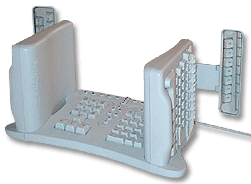
... and physically if you cling to the keyboard so much that you develop repetitive stress injuries. Oh, my. Those fingers and wrists and hands can hurt.

A member of the IWW posted a lament on the WRITING discussion group forum recently. My advice ...

  • Posture
  • Comfortable chair and desk
  • Monitor mounted in good position
  • Get rid of bifocals and use a pair of "computer-only" glasses
  • Type 50 minutes
  • Get up and move for 10 minutes
  • Gel pads for keyboard and mouse
  • Make certain position of arms in using mouse/keyboard isn't pinching
  • off circulation or nerve path to hands
  • Rubber squeeze ball near computer
Does it work? I'm not sure. I know I followed most of that advice, but I continued to have a subtle soreness in my wrists. The promise of more pain didn't recede until I put away the desktop and began to use a laptop -- literally, a laptop on my lap.

Another member of the IWW said " ... the writer John August recommends a keyboard on his site."

I did a quick search to find an odd-appearing, interesting device that resembles an accordion more than a keyboard.

I think I'll stick to laptops.


More on repetitive stress injury here and here

Thursday, May 3, 2007

Fiction's Fifth "W"

Fiction's fifth "W"
by Dave Swinford

Beginning journalists are advised to provide the "Who, What, Where, When and How" and to get the four "w's" into a story as quickly as is possible. It's sound advice that also applies to fiction by translating the Who into Characters, the Where into Setting, the When into Time frame, the What into Problem, Conflict and/or Theme, and the How into basic Plot.

However, authors of fiction also need to provide readers with a fifth "W" not required of journalists. In addition to Characters, Setting, Time frame, Problem, Conflict and/or Theme, readers of fiction also want the "Why's" of a story. They want to know what motivates the principal characters. Why are those characters acting and behaving as they do when confronted with each new story problem. And, like the basic four "W's", readers of fiction hope to understand some of the "Why's" driving each character after only the shortest of acquaintances with that character.

Experienced authors of fiction understand that the more quickly and effectively they give the reader the five "W's" of a story, the more quickly and effectively they draw that reader into their fictional reality. Here's the opening paragraphs from Andre Norton's 1958 novel, Time Traders. Norton, a prolific author of science fiction, skillfully and quickly provides the reader with the five "W's".
To anyone who glanced casually inside the detention room the young man sitting there did not seem very formidable. In height he might have been a little above average, but not enough to make him noticeable. His brown hair was cropped conservatively; his unlined boy's face was not one to be remembered--unless one was observant enough to note those light-gray eyes and catch a chilling, measuring expression showing now and then for an instant in their depths.

Neatly and inconspicuously dressed, in this last quarter of the twentieth century his like was to be found on any street of the city ten floors below--to all outward appearances.

But that other person under the protective coloring so assiduously cultivated could touch heights of encased and controlled fury which Murdock himself did not understand and was only just learning to use as a weapon against a world he had always found hostile.

He was aware, though he gave no sign of it, that a guard was watching him. The cop on duty was an old hand--he probably expected some reaction other than passive acceptance from the prisoner. But he was not going to get it. The law had Ross sewed up tight this time. Why didn't they get about the business of shipping him off? Why had he had that afternoon session with the skull thumper? Ross had been on the defensive then, and he had not liked it. He had given to the other's questions all the attention his shrewd mind could muster, but a faint, very faint, apprehension still clung to the memory of that meeting.

The door of the detention room opened. Ross did not turn his head but the guard cleared his throat as if their hour of mutual silence had dried his vocal cords. "On your feet, Murdock! The judge wants to see you."

Ross rose smoothly, with every muscle under fluid control. It never paid to talk back, to allow any sign of defiance to show. He would go through the motions as if he were a bad little boy who had realized his errors. It was a meek-and-mild act that had paid off more than once in Ross's checkered past. So he faced the man seated behind the desk in the other room with an uncertain, diffident smile, standing with boyish awkwardness, respectfully waiting for the other to speak first.
In a few paragraphs, Norton introduces the reader to Ross Murdock, a young man residing in an unnamed city in the late twentieth century, who has been apprehended for an unspecified crime and who faces certain punishment. She shows rather than tells the reader that Murdock is driven by a desire to control himself and as much of his situation as is possible.

As the story progresses, new circumstances may generate new "Why's" for Ross Murdock, but the desire to control himself and his situation will continue to influence his choices and actions. His me-versus-a-hostile-world attitude is an essential aspect of Murdock's character.

Thus, authors of fiction need to understand the "Why's" of each major character and to show that character to the reader in a way that exposes those inner desires and drives. A character's motives are often directly linked to the conflicts of a story. This is especially true if one is writing a character-driven story, because in a character-driven story, it is the inner needs and desires that propel the character and events.

Taking time to consider each character's motives can also be a way of fleshing out an original story idea. It may lead to interesting sub-plots and/or suggest different ways of presenting and playing out the central conflicts. Considering a character's motives may even be a way of generating entirely new story ideas.

Thus, the time an author of fiction spends nailing down the fifth "W" can pay excellent dividends for both the author and the reader.

Link: Time Traders


Dave Swinford is an Internet Writing Workshop administrator.

Thursday, April 12, 2007

Rewriting From a Different Point of View

An Essay on Craft
by Dave Swinford, an IWW Administrator

When writing from multiple points of view (POV), the writer must decide which POV works best for each scene. Once the first draft is complete and it's rewrite time, it may also be time to reevaluate each scene in terms of the point of view. Might the scene work better from a different character's POV? Might it create more tension to shift POV within a scene?

If the answer is, "yes," you then face the challenge of rewriting the scene from a different point of view. Will that require reworking the entire scene? Usually it's not necessary to do a full rewrite. The events, actions, descriptions and dialogue need not change; only the POV character's reactions to those events, actions and dialogue require rewriting.

In an earlier essay on shifting point of view within a scene, I presented an example of shifting POV. I'm going to rewrite that example to maintain a single point of view. Here's that example in which character A, Kelly, has been delivering a report to character B, Carson. The report has been routine until the last item, which presents an unexpected twist. All of this has been written through the POV of Kelly, who concludes her report with:

"What do you make of it, sir? I have to admit, I was totally gobsmacked." She leaned forward, not having to fake her interest. She truly wanted to know what the Super thought.

Carson reached and meticulously aligned the papers in the open folder. He knew he was stalling, but he hated having the unexpected lobbed at him, especially when it was followed by a request for his input. It wouldn't do for a superior to admit he had no ready response, so he would do as his own Super had so often done. He would toss the ball back into the junior's court.

"A good, succinct report, Kelly. However, before I offer input on the final item, I feel I need more information. You were on the scene. I was not. Other than being gobsmacked, what was your initial response?"

The eager anticipation in Kelly's eyes vanished like a light being switched off. Clearly, she was taking his response as a criticism or reprimand. Why did female officers have to be so bloody sensitive and take everything so bloody personal? If he were going to offer an intelligent reply, he really did need more information.

Now, here's a rewrite of this example maintaining Kelly's POV:

"What do you make of it, sir? I have to admit, I was totally gobsmacked." She leaned forward, not having to fake her interest. She truly wanted to know what the Super thought.

The Super reached and meticulously aligned the papers in the open folder. She recognized the gesture. A delaying tactic to allow time to consider his reply. She could wait. She had become very good at waiting.

Finally, he raised his gaze from the papers and said, "A good, succinct report, Kelly. However, before I offer input on the final item, I feel I need more information. You were on the scene. I was not. Other than being gobsmacked, what was your initial response?"

Her anticipation congealed into a cold lum that lodged in the pit of her stomach. Good report ... except, of course, not enough details. Bloody hell. What did it take to please this man?

In the new version, Carson's aligning of the papers is observed and filtered through Kelly's consciousness. Note that an additional bit of logical action has been added. She is waiting for Carson to look up prior to speaking. From her POV, this action was needed, while from Carson's POV, it was not.

Also note that Kelly's reaction to Carson's reply is a feeling rather than an observation. She cannot observe her own eyes and how they changed. She can only observe and react to what she is feeling. Maintaining a consistent POV requires the author to limit information to only things the POV character knows or can observe.

You now have two versions of this scene, and you, the writer, can decide which works best for your story. Rewriting also provides an opportunity to further develop your character, polish the scene, and practice the craft techniques of establishing and maintaining point of view.

In fact, one may wish to select a scene and rewrite it from a different point of view simply as an exercise in establishing, maintaining and shifting POV. It's excellent practice, and as with all craft techniques, the more one practices, the easier the techniques become.

Wednesday, March 28, 2007

Tips for the Serious Researcher

An Essay by Terri Main

Use the telephone. Email is fine, but there is something a bit more personal about a voice on the phone. If local, set an appointment for a face-to-face meeting. Incidentally, I've never had anyone refuse to talk to me. Maybe I'm just lucky, but it's true.

I call a specific person if I can find a name. Then I say, "Hello, Mr/Ms/Dr/_______ I'm Terri Main, I'm a freelance writer working on a story about _______________. I understand that you are an expert about this subject and I would like to arrange a time when we could talk on the phone about it. "

I have my questions handy in case they say, "Well, why not now?" but I have given them the courtesy of offering to call at the most convenient time.

Use referrals. At the end of each interview, I ask, "Is there anyone you think I should talk to about this?" Then I use that sources name when I call.

Check the universities, colleges, community colleges and even high schools. By their very nature schools are repositories of experts. You can find out about police procedure just as easily by talking to an Administration of Justice professor at a college based police academy as you can from a police officer, probably more, because the cop can only tell you his personal experience whereas the professor (who is usually a retired cop) has information about various police departments, and is not bound by department protocols.

Make friends with the PR people. You can often arrange interviews through them. They aren't trying to keep you away from anyone. Most want as much publicity for their organization as they can get. Unless you are writing an expose or something like that, they will often arrange the interviews for you. It's just that they have a legitimate need to have a central clearing house for information to pass through.

With universities again, get on their mailing lists for press releases. You'd be surprised what you can learn from them and get a list of experts to consult later.

Check out nonprofits. The heads of places like the local American cancer society can possibly put you in touch with or even arrange the interview with a local cancer researcher.

Tuesday, March 27, 2007

Shifting Point of View Within a Scene

An Essay by IWW Admin Dave Swinford


You've elected to tell your story using multiple points of view. So far, you have written each scene or chapter in the POV of a single character, letting the scene breaks or chapter breaks indicate a shift in POV. Now, for various reasons, you want to start the scene in character A's POV and near the middle of the scene, shift the point of view to character B. So, how to accomplish this without confusing or startling the reader?

Simply ending the first section of the scene in character A's POV and starting the next paragraph in character B's POV is usually too abrupt a shift. It may surprise readers and jar them out of the fictional reality you have worked to establish.

As with most craft issues, there is no single best or correct way to shift point of view within a scene, but I have found it helps to signal the shift in a way that logically draws the reader's attention from character A to character B.

I liken it to a relay race. The audience watches the progress of the race by focusing on runner one, who is carrying the baton. When runner one reaches runner two, there is an exchange of the baton, and the audience now knows that runner two is carrying the race.

The simple physical act of passing the baton signaled this shift , and one can employ a similar technique when shifting point of view within a scene.

For example, in the first half of the following scene, character A has been delivering a report to character B. The report has been routine until the last item, which presents an unexpected twist. All of this has been written through the POV of character A, who concludes her report with:

"What do you make of it, sir? I have to admit, I was totally gobsmacked." She leaned forward, not having to fake her interest. She truly wanted to know what the Super thought.

Carson reached and meticulously aligned the papers in the open folder. He knew he was stalling, but he hated having the unexpected lobbed at him, especially when it was followed by a request for his input. It wouldn't do for a superior to admit he had no ready response, so he would do as his own Super had so often done. He would toss the ball back into the junior's court.

"A good, succinct report, Kelly. However, before I offer input on the final item, I feel I need more information. You were on the scene. I was not. Other than being gobsmacked, what was your initial response?"

The eager anticipation in Kelly's eyes vanished like a light being switched off. Clearly, she was taking his response as a criticism or reprimand. Why did female officers have to be so bloody sensitive and take everything so bloody personal? If he were going to offer an intelligent reply, he really did need more information.

The simple action of character B straightening the papers drew the reader's attention and signaled the logical shift into his point of view. Had the paragraph begun with Carson's reaction, "...he really hated having the unexpected lobbed at him, especially when it was followed by a request for his input....", the reader would have been switched from the POV of Kelly to that of Carson without warning, a shift that might have jarred the reader out of the fictional reality. That small bit of action, the aligning of the papers, provided a bridge from one point of view to the other, making the shift feel logical and smooth.

So, if you do want to shift point of view within a scene, one good way to signal that shift is to use a bit of action to draw the reader's attention from POV character A to POV character B. Pass the baton smoothly, and most readers will follow the shift without even thinking about it.

Friday, March 23, 2007

Writing Challenges

Sandra Smith says, "Some of you might find this of interest.

"Look on bottom right and click on writing challenges.

"They're presenting a writing course under the title of book in a year.

"I just saw it, so not sure exactly how it works, but apparently they're doing a section a month, starting with plot. The second one is characterization, and the current one is conflict.

"They also have articles on writing a synopsis, publishing glossary, what proofreader's marks mean, etc.

"Although Harlequin publishes romances, most of this information applies to all genres.

"I am not associated with this site in any way, and will not receive benefit in any form if you should happen to visit it. I'm simply passing along information to those who might be interested in writing/publishing tips."

Sandra writes under the name of Cassandra Barnes, and her latest novel is Jenny's Legacy.

Thursday, March 15, 2007

The Joys of Research

The Joys of Research
by Carter Jefferson

This afternoon I visited the Boston Public Library, where a fifty-ish man with a mop of white hair fit for a Dickens movie helped to make my day.

For some time I've been messing around with stories about an Irish woman, in 1886 one of the first "typewriter girls" in Boston. Some of those fictions were subs for exercises for Practice-w; none has been worked over and submitted for publication.

About a year ago, I read a whole slew of histories of women, and of Boston, all of which strongly implied that my stories had to be fairy tales, because no Irish girl could get such a job in Boston at that time -- the heavily Anglo-Saxon ruling class called the Irish trash, and kept them in the most menial positions. No question, those experts were right about the anti-Irish sentiment, and that women in general got very few decent jobs. That sort of cooled my enthusiasm for Katie.

But she kept coming back to mind. I read somewhere that the public library employed a few women at that time, so one day I asked at the welcome desk if the library had records I could look at. The greeter didn't know, but he gave me the phone number of a man he thought could help. A few weeks later I called the number. No answer, so I left a message asking that he call me back, though I considered that unlikely. But in less than an hour there he was, and he told me to go to the microtext room and ask for city records. That's what I did today.

The bushy-haired man not only had the records, he produced a reel of microfilm in only a few minutes, telling me all the while things I already knew about the history of Boston. I had to look at some excellent photos he'd taken of various gravestones in local cemeteries first, but finally, after scrolling through reports of the activities of the police, accounts of the street department's expenses, and the transcript of a long civil suit, I wound up with what the library had reported in 1885.

Six -- count 'em, six! -- of the library's 146 employees were women with Irish names. One was assistant librarian at the North End branch; others had responsible positions. A Miss -- we can be pretty sure she was a "Miss" -- Mary McGrath had worked there since 1868.

So Katie can get a job, if she has the right credentials, and you can be sure she will, for she has a job to do for me.

Morals: Don't believe everything you hear or read, no matter who tells you. And if you want to know something, there's probably a way to find out.

Monday, March 12, 2007

Want to Watch a Book?

By Florence Cardinal

When I was a kid back in the forties, we didn't have TV - not even the old grainy black and white variety. And movies? Dad was a farmer, trying to scratch out a living on a quarter section of land. We were still suffering from the ravages of the Great Depression. Movies were a luxury. If I got to see an afternoon matinee once a month during the summer, I considered myself lucky.

What we did have, though, was the radio, a big old monster of a thing that stood in a corner of the living room and drew its power from a car battery. Most nights, that's where you'd find us, gathered around the living room, watching the radio.

And watch it we did. I don't mean we literally stared at it, though some of us did. What I meant is that we "watched" the stories in our imaginations. My favorite spot was lying on the rug with my eyes closed.

"Who knows what evil lurks in the hearts of men? The Shadow knows!" That show sent shivers down my back. I could see, in my mind's eye, this dark figure lurking in the shadows. When Inner Sanctum came on the air with its eerie music, I "saw" that creaking door slowly opening.

Other shows I remember - the Lux Radio Theater with everything from mysteries to comedies to light-hearted or sometimes tragic romances, even westerns rife with six shooters and hoof beats. Radio City Playhouse had one show you would all have loved -Theatre Of Romance, with plays like Lost Horizon and Seventh Heaven and Magnificent Obsession.

You're probably wondering what old time radio shows have to do with writing. The point is, we "watched" those shows. We actually saw the action taking place in our imaginations. Except for a few minor sound effects, all we heard were words - most of that dialogue, but it was enough to get the story across, and vividly.

Nowadays, we have television, where we see the images as well as hear the words. The problem with television is we are all forced to see the same picture. Listening to the radio, when the handsome hero burst onto the scene, some saw him as tall with dark eyes and long curling ebony hair. Others picture him as blond, blue-eyed and stocky. The same with the heroine, or the scenery or even the interior of a building. Every person had his or her own vision.

We are writers. Our mission is to do with the words in our book what the old time radio shows did. Give the readers just enough of the picture to set their imaginations on fire. A brief description of a character is better than a two-page essay on his hair and eyes and the way he wears his shirt. If you lead readers into a castle, it's not necessary to take them on a room by room tour. You're using the place as a setting, after all, not trying to sell it.

What I'm trying to get across with all this is that we don't have a television screen to show readers what they should see. We have more. We have our words and their imaginations - and that should be more than enough to make our books come alive.

Sunday, March 11, 2007

Things to Watch in Revisions: Cliches, Point of View

By Mel Jacob
Chats offer a variety of discussion topics and advice, some good, some bad. Two recent discussions raised some useful points. Metaphors and similes can liven up our writing provided they aren't too cute or don't descend into groaners, i.e., too many puns. It's all too easy to write in clichés and not even realize it. Always read your material and eliminate these pesky sayings or consider other ways to say them. Dialogue may be an exception, but don't have all your characters speak this way. One character who overuses clichés is enough.

So, when you discover these phrases, what do you do about them? One writer advises changing one word. With an apt new word, you can create something new and original. Consider as an example: slow as molasses in January. Maybe try: slow as a turgid creek in August. Not great, but you get the idea. Play with words and meanings until you find the best word to suit your material, setting, your character, and the point of view in use.

Another chat with Linda Vernon dealt with point of view in commercial novels. She based much of her discussion on Sherri Szeman's _Mastering Point of View_ (1884910521, Story Press, 2001). Those interested in her excellent presentation should contact Hillwithit@aol.com. An important point to remember: we can have a character aware of actions (smiles, even blushes), but not their appearance unless they are contrasting it with another character's or something in the scene. Vernon also cautioned against confusing the character's perspective with point of view. An example: Opening one red-rimmed orb, (character name) (action). A character can't see his eyes as red-rimmed. Only another character could observe that.

Another aspect of point of view relates to focus: up close and through the POV character's eyes or cinematic, which usually refers more to an omniscient narrator or observer. Ken Follet used this to open _Pillars of the Earth_ before going into a more intimate point of view.

Vernon observed how word choice influences the reader's view of characters. Most villains are described in negative terms using words like: hulking, menacing, devious, isolated, strident, etc. Heroes are described as: honest, loyal, diligent, kind, etc. The words used to describe the character carries the author's view of them, their actions, dialogue, and emotions. Such words can either tell or show depending on whether they represent the POV character's reaction or emotions.

Point of view gives many writers problems so understanding it becomes essential. Vernon has promised to discuss other aspects of point of view in future chats.

Thursday, March 8, 2007

Buried Gems on the Main IWW Site

Greg Gunther, the Internet Writing Workshop's chief administrator, said recently, "Our workshop's web site has a lot of useful information to help you with your email settings, such as, signoff, nomail, and others you might find interesting.

"If you have formatting problems with your posts to your lists, check out this page. Chances are your answers will be there.

"If you want to reach any of our admins, you can find their workshop addresses here.

"Please note that a message sent to these addresses will come back to you from listserv for authentication -- that is, it will ask you to click on a link it presents to you. That's to stop spammers, who never click on those links.

"Any of those choices are far superior to sending a help request to the Writing list."

Saturday, March 3, 2007

Saving Your Precious Work

Saving Your Precious Work
Carter Jefferson

Back when writers used paper, that ancient means of putting thoughts into circulation and saving them, famous authors lost precious manuscripts to fire, flood, or simple mischance. Ralph Ellison saw 350 pages of his second novel go up in smoke at his summer house in 1966.

Now we use electronic means, but we face the same danger of loss.

For example, when I publish something in an e-zine, I usually want a copy to save with the fancy art work that surrounds it. I used to simply save a link, but then learned better. Beware! These outfits disappear, or sometimes they simply dump their archives. So now I go to the piece and click on "save page as . . . ," which produces a folder and an HTML file. Then it's on my hard drive permanently. Posterity will no doubt be grateful.

What about the draft of your novel? It's on your hard drive. But hard drives break down, and you could be out of luck. Here are some ways to avoid losing things precious to you.

First, get an external hard drive, plug it in, and copy all your important files. When your primary drive goes on the fritz, your works are safe.

Make CDs that contain those vital folders. Use a flash drive--those can cost as little as $15 for surprising amounts of space.

All those things are, however, still in your house, which could explode and take them with it. Consider storing things on the Web. Send your important files in e-mails to an account that gives you a large storage allowance--G-mail is one of those. You can buy Web storage, and at least two sites, 4-shared and X-Drive, offer generous amounts of free storage. (Check all these out--I don't guarantee anything,)

And, as a last resort, copy all those CDs, put them in a box, and ask your Aunt Minnie to let you store them in her attic. Nothing like belt and suspenders both!

(Internet Writing Workshop members John Meyer, Louisa Homerow, Terri Main, and Paul Stenquist helped me compile this information.)